
Search
Remove Ads
Advertisement
Search Results

Article
Dogen's One Bright Pearl & the Neo-Confucian Pattern
The concept of Oneness is expressed repeatedly in philosophical works both in the east and west. Whether one is reading the Paradoxes of Zeno of Elea (l. c. 465 BCE) or the treatises of Wonyho (l...

Article
Dogs in Ancient China
Dogs are the oldest domesticated animal in China and were bred as guardians, for transporting goods, for herding, hunting, and as a food source. Archaeological evidence dates the domestication of the dog in China at approximately...

Article
The Bronze Bells of Ancient Korea
The metalworkers of ancient Korea were highly skilled artists and some of their finest surviving works are the large bronze bells cast for use in Buddhist temples and monasteries. Both the Unified Silla kingdom and...

Article
The Temple of the Emerald Buddha
A small carved figurine sits high on a grand multi-tiered pedestal in a magnificent wat (temple) in Bangkok, Thailand. It has been sitting there since 1784 CE and was originally thought to be made of emerald. Hundreds...

Article
Daily Life in Ancient China
Daily life in ancient China changed through the centuries but reflected the values of the presence of gods and one's ancestors in almost every time period. Villages like Banpo show evidence of a matriarchal society, where...

Definition
Hwarang
The hwarang was a state-sponsored organisation for the education of elite young males in the ancient kingdom of Silla, Korea. Variously translated as the 'Flower Boys,' 'Flowering Youth,' or 'Elite Youth' (and sometimes, too, the rather...

Definition
Izumi Shikibu
Izumi Shikibu was a writer, poet, and member of the Japanese court during the Heian Period (794-1185 CE). Her birth date is variously given as sometime in the 970's CE, and she died in the 1030's CE. In her celebrated memoirs, known...

Definition
Emperor Gaozu of Tang
Emperor Gaozu (also Kao-tsu, formerly Li Yuan, r. 618-626 CE) was a Sui military commander who led a rebellion against his former masters, seized control of the state, and founded the Tang Dynasty (618-906 CE). Overshadowed...

Definition
Early Joseon Period
The Early Joseon Period (1392 - c. 1550 CE) in Korea was bookended by internal power struggles but witnessed major scientific and societal advances and prosperity. The Joseon (Choson) Dynasty ruled Korea from 1392 CE to 1897...
Definition
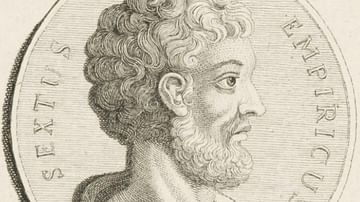
Sextus Empiricus
Sextus Empiricus (l. c. 160 to c. 210 CE) was a Greek Skeptic who developed the ideas of the earlier Greek Skeptic philosopher Pyrrho of Elis (l. c. 360 to c. 270 BCE) who claimed that tranquility of mind was attainable by suspending...
