
Search
Remove Ads
Advertisement
Search Results

Image
Jomon Period Dogu
This is a headless dogu. Earthenware figures (dogu) were important in the Jomon period and as many as 1000 have been found at some sites. Some seem to represent imaginary animals but most are human in shape. Are they females...

Image
Japanese Beads from the Kofun Period
These beads come from Japan and date from the Kofun period (250-538 CE) in Japanese history. In the Kofun Period beads of various shapes and materials were worn as fashion accessories, used in rituals, and buried...

Image
Warring States Period Swords
Swords of the Warring States Period (481-221 BCE) in China. The left sword is of iron while the other two are of bronze. (Shaanxi Provincial Museum, Xian, China)

Image
Uruk-Period Beveled Rim Bowl
Beveled rim bowl, from Nippur, Late Uruk period, c. 3300–3100 BCE.
Metropolitan Museum of Art, New York.
Image
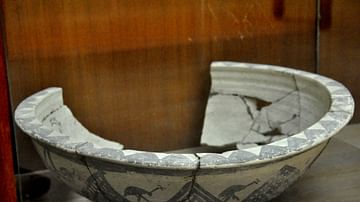
Pottery Dish from Uruk Period
The outer surface of this large, partially broken, pottery dish is painted in black geometric shapes and pelicans ,while the inside (not shown) is painted with ibex figures. Uruk period, 3500-2800 BCE, Mesopotamia...

Image
Necklace from the Old Babylonian Period
This necklace was found inside a grave that dates back to the old Babylonian period, 2000-1500 BCE, Mesopotamia, Iraq. (The Sulaimaniya Museum, Iraq).

Image
Maitreya Buddha, Three Kingdoms Period
A detail of a gilt bronze statue of the Maitreya (coming) Buddha. Three Kingdoms Period, Korea, c. 600 CE. Height: 80 cm. (National Museum of Korea, Seoul, South Korea)
Image
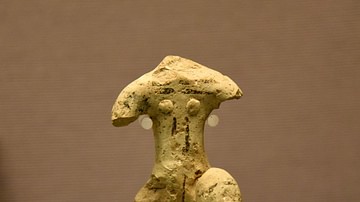
Halaf Period Female Figurine
Female figurine of a seated woman. Fired clay. Halaf Period, 6000-5000 BCE. From Chagar Bazar, modern-day Al-Hasakah Governorate, Syria. (The British Museum, London)

Image
Shaft-Hole Axe from Early Dynastic Period
This shaft-hole axe dates back to the early dynastic period,2800-2350 BCE, Mesopotamia, Iraq. (The Sulaimaniya Museum, Iraq).
Image
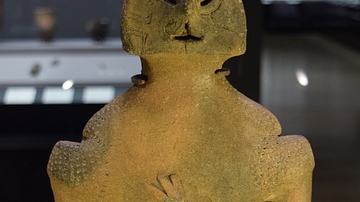
Dogu Figurine, Jomon Period
A clay dogu figurine. From Kamikurokoma, Fuefuki-shi, Yamanashi, Japan. Jomon Period, 3000-2000 BCE. (Tokyo National Museum)
