
Search
Remove Ads
Advertisement
Search Results

Article
Ancient Japanese & Chinese Relations
Relations between ancient Japan and China have a long history, and in certain periods the exchange of political, religious and cultural practices between the two was intense. China, the much older state and the...

Definition
Nihon Shoki
The Nihon Shoki ('Chronicle of Japan' and also known as the Nihongi) is an official history of Japan which was written by a committee of court scholars in 720 CE. It is a compilation of myths and legends concerning the Shinto gods...

Definition
Shinto
Shinto means 'way of the gods' and it is the oldest religion in Japan. Shinto's key concepts include purity, harmony, family respect, and subordination of the individual before the group. The faith has no founder or prophets and there...

Definition
Middle Kingdom of Egypt - Ancient Egypt's Classical Age
The Middle Kingdom (2040-1782 BCE) is considered ancient Egypt's Classical Age, during which it produced some of its greatest works of art and literature. Scholars remain divided on which dynasties...

Image
Map of the Third Intermediate Period
A map showing the political divisions in ancient Egypt during the Third intermediate Period, about 730 BC. The rulers of the 22nd and 23rd Dynasties ruled simultaneously, alongside Libyan chieftains controlling...

Image
Map of the ancient Near East during the Amarna Period
Map of the ancient Near East during the Amarna Period, showing the great powers of the period: Egypt (green), Hatti (yellow), the Kassite kingdom of Babylon (purple), Assyria (grey), and Mittani (red...

Image
Three Kingdoms Period of China and the Rise of Xianbei in the year 229 CE
This map depicts the boundaries of all major civilizations in East Asia at the beginning of the Three Kingdoms Period of China, with italics indicating nomadic bands and other tribal...

Image
Egypt in the Early Hyksos Period
Egypt and its political situation during the Second Intermediate Period (c. 1782 - c.1570 BCE), in which the Hyksos held power in the North and the Nubians held power to the South.
Image
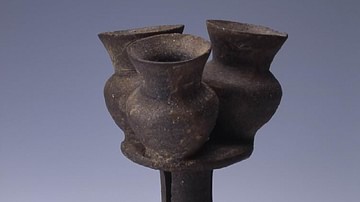
Sueki Stoneware from the Kofun Period
Three jars on pedestal platform, made of high-fired stoneware with natural ash glaze, from early 6th century Kofun Period Japan.
Image
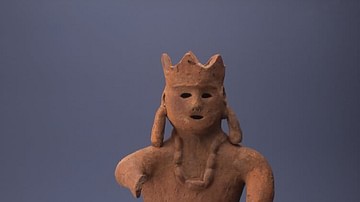
Haniwa, Kofun Period
Terracotta Haniwa figure from Kofun Period Japan.
