
Search
Remove Ads
Advertisement
Search Results
Definition
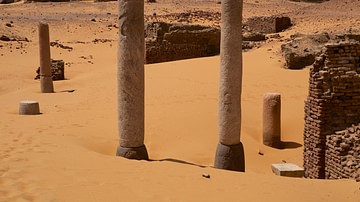
Old Dongola
Old Dongola (aka Dungulah or Dunkula), located in modern Sudan, was the capital of the ancient Nubian kingdom of Dongola (aka Makuria or Makurra) which flourished from the 6th to 14th century CE. A Christian kingdom for at least 750 years...

Definition
Ostia
Ostia (or Ostia Antica) lies 15 km from the city of Rome for which it served as the city's principal port and harbour throughout antiquity. The name derives from 'os' or 'ostium' which means 'mouth' and refers to the city's location at the...

Definition
Chepstow Castle
Chepstow Castle, located in Monmouthshire, South Wales, was first built c. 1067 by William FitzOsbern and then significantly improved c. 1190 CE by Sir William Marshal (c. 1146-1219 CE), one of England's greatest ever knights who served four...
Definition
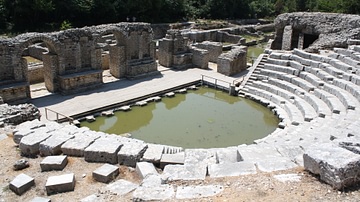
Butrint
Butrint (ancient name Buthrotum) is located on the fertile coast of Epirus in present-day Albania and was an important settlement in Hellenistic and Roman times due to its position on the route from Italy to mainland Greece down the Ionian...

Definition
Glanum
Glanum, located near St-Rémy-de-Provence in southern France, was a Greek and then Roman town which prospered due to its location on trading routes between Italy and the Rhodanus (Rhone River). The town benefitted from a large building project...

Definition
Nijo Castle
Nijo Castle, located in Kyoto, Japan, was first built in 1603 CE by Tokugawa Ieyasu (r. 1603-1605 CE), founder of the Tokugawa Shogunate (1603-1868 CE). The castle complex is surrounded by a double moat and made up of three distinct areas...

Image
Circus of Maxentius, Towers and Starting Gates
The Circus of Maxentius is the best-preserved Roman circus in Rome and is second only in size to the Circus Maximus. It lies outside the city, between the second and third milestones along the Appian Way (Via Appia). This circus was part...

Image
Circus of Maxentius, Spina
The Circus of Maxentius is the best-preserved Roman circus in Rome and is second only in size to the Circus Maximus. It lies outside the city, between the second and third milestones along the Appian Way (Via Appia). This circus was part...
Image
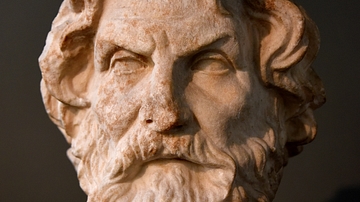
Antisthenes, Cynic Philosopher
Antisthenes (450-370 BCE) was the founder of the Cynic school of philosophy. From near the Via Appia, Rome. Roman copy of a lost Greek original of the late 3rd or 2nd century BCE. (British Museum, London)
Image
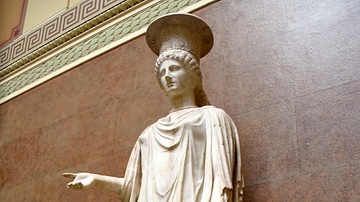
The Townley Caryatid
In Greek and Roman architecture, Caryatids are female figures that stand in place of columns. This example was found in 1585-90 CE near the Via Appia outside Rome. It was acquired by the Peretti family and was kept at the Villa Peretti Montalto...
