
Search
Remove Ads
Advertisement
Search Results

Definition
John Wycliffe
John Wycliffe (l. 1330-1384, also John Wyclif) was an English theologian, priest, and scholar, recognized as a forerunner to the Protestant Reformation in Europe. Wycliffe condemned the practices of the medieval Church, citing many...

Definition
Council of Trent
The Council of Trent (1545-1563) was a meeting of Catholic clerics convened by Pope Paul III (served 1534-1549) in response to the Protestant Reformation. In three separate sessions, the council reaffirmed the authority of the...

Definition
Meiji Period
The Meiji period refers to the period in Japanese history from 1868 to 1912 during which the Meiji Emperor reigned. Following the overthrow of the Tokugawa shogunate in the Meiji Restoration of 1868, Japan's new leaders embarked...

Definition
Committee of Public Safety
In the French Revolution (1789-1799), the Committee of Public Safety (French: Comité De Salut Public) was a political body created to oversee the defense of the French Republic from foreign and domestic enemies. To achieve...
Definition
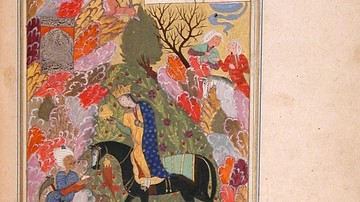
Khamsa of Nizami
Khamsa (also known as Quintet or Panj Ganj) is the best-known work of Nizami Ganjavi (c. 1141-1209 CE) and without a doubt one of the most prominent works of Persian literature. Written during the last decades of the 12th century...

Definition
Germ Theory
The germ theory, which emerged in the late 19th century, demonstrated that microscopic germs caused most human infectious diseases. The germs involved included bacteria, viruses, fungi, protozoa, and prions. Louis Pasteur (1822-1895...

Definition
Anschluss
The Anschluss ('fusion') of 12 March 1938 was the annexation and formal union of Austria with Germany. Adolf Hitler (1889-1945), the Nazi leader of Germany, dreamed of an empire which enclosed all German speakers, his 'Greater Germany'...

Definition
Miklós Horthy
Miklós Horthy (1868-1957) was a Hungarian admiral and statesman who served as regent for the Kingdom of Hungary from 1920 until his forced abdication in 1944. During the interwar period and for most of World War II, Horthy played...

Definition
Battle of Thermopylae
Thermopylae is a mountain pass near the sea in northern Greece which was the site of several battles in antiquity, the most famous being that between Persians and Greeks in August 480 BCE. Despite being greatly inferior in...

Definition
Ashoka the Great
Ashoka the Great (r. 268-232 BCE) was the third king of the Mauryan Empire (322-185 BCE) best known for his renunciation of war, development of the concept of dhamma (pious social conduct), and promotion of Buddhism as well as...
