
Search
Remove Ads
Advertisement
Search Results

Definition
Anaxagoras
Anaxagoras (l. c. 500-c. 428 BCE) was a Pre-Socratic Greek philosopher who claimed the First Cause of existence was Mind (nous) and all things were constituted of indestructible “seeds” (or “stuff”), originally a single mass, separated...

Definition
The Hittites
The Hittites occupied the ancient region of Anatolia (also known as Asia Minor, modern-day Turkey) prior to 1700 BCE, developed a culture apparently from the indigenous Hatti (and possibly the Hurrian) people, and expanded their...

Definition
Ptolemaic Egypt
Ptolemaic Egypt existed between 323 and 30 BCE when Egypt was ruled by the Macedonian Ptolemaic dynasty. During the Ptolemaic period, Egyptian society changed as Greek immigrants introduced a new language, religious pantheon...
Definition
Romanos I
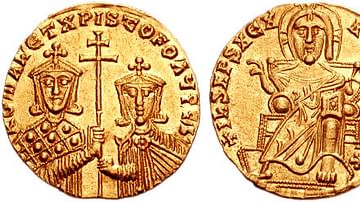
Romanos I Lekapenos (“the Ignorant”) was emperor of the Byzantine Empire from 920 to 944 CE. Of Armenian descent, he was a military commander who usurped the throne to rule as co-emperor with the rightful heir, but still minor, Constantine...

Definition
Byzantine Government
The government of the Byzantine Empire was headed and dominated by the emperor, but there were many other important officials who assisted in operating the finances, judiciary, military, and bureaucracy of a huge territory...

Definition
Kabbalah
The term Kabbalah refers specifically to the form of Jewish mysticism that became widespread in the Middle Ages. However, in recent decades it has essentially become a generic term for the entirety of Jewish mystical thought. Literally...

Definition
Rashidun Government
The Rashidun Caliphate (632-661 CE) was responsible for setting up the basis of the Islamic empire and expanding its borders beyond the Arabian soil. These leaders were selected by the consent of the people and based on their...

Definition
Rumi
Jalal ad-Din Muhammad Rumi (also given as Jalal ad-did Muhammad Balkhi, best known as Rumi, l. 1207-1273 CE) was a Persian Islamic theologian and scholar but became famous as a mystical poet whose work focuses on the opportunity for a...

Definition
Nicolaus Copernicus
Nicolaus Copernicus (1473-1543 CE) was a Polish astronomer who famously proposed that the Earth and other planets revolved around the Sun in a heliocentric system and not, as then widely thought, in a geocentric system where...

Definition
RMS Titanic
The RMS Titanic was a White Star Line ocean liner, which sank after hitting an iceberg on its maiden voyage from Southampton to New York on 15 April 1912. Over 1,500 men, women, and children lost their lives. There were 705 survivors...
