
Search
Remove Ads
Advertisement
Search Results

Definition
Committee of Public Safety
In the French Revolution (1789-1799), the Committee of Public Safety (French: Comité De Salut Public) was a political body created to oversee the defense of the French Republic from foreign and domestic enemies. To achieve...
Definition
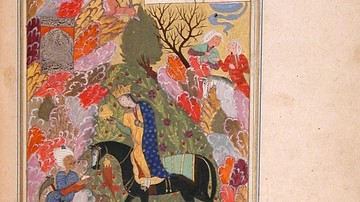
Khamsa of Nizami
Khamsa (also known as Quintet or Panj Ganj) is the best-known work of Nizami Ganjavi (c. 1141-1209 CE) and without a doubt one of the most prominent works of Persian literature. Written during the last decades of the 12th century...

Definition
Germ Theory
The germ theory, which emerged in the late 19th century, demonstrated that microscopic germs caused most human infectious diseases. The germs involved included bacteria, viruses, fungi, protozoa, and prions. Louis Pasteur (1822-1895...

Definition
Anschluss
The Anschluss ('fusion') of 12 March 1938 was the annexation and formal union of Austria with Germany. Adolf Hitler (1889-1945), the Nazi leader of Germany, dreamed of an empire which enclosed all German speakers, his 'Greater Germany'...

Definition
Miklós Horthy
Miklós Horthy (1868-1957) was a Hungarian admiral and statesman who served as regent for the Kingdom of Hungary from 1920 until his forced abdication in 1944. During the interwar period and for most of World War II, Horthy played...

Definition
Stakhanovite Movement - Labour Productivity in Stalin's USSR
The Stakhanovite movement took its name from the Soviet coal miner Alexei Stakhanov (1906-1977), who produced a prodigious amount of coal in a single shift in August 1935. Championed as an example...

Definition
Parthenon - Temple of Athena Parthenos
The magnificent temple on the Acropolis of Athens, known as the Parthenon, was built between 447 and 432 BCE in the Age of Pericles, and it was dedicated to the city's patron deity Athena Parthenos. The temple...

Definition
Diocletian
Diocletian was Roman emperor from 284 to 305 CE. After the defeat and death of the Roman emperor Philip the Arab in 249 CE, the empire endured over three decades of ineffective rulers. The glory days of Augustus, Vespasian, and Trajan...

Definition
Indus Valley Civilization
The Indus Valley Civilization was a cultural and political entity which flourished in the northern region of the Indian subcontinent between c. 7000 - c. 600 BCE. Its modern name derives from its location in the valley...

Definition
Democritus
Democritus (l. c. 460 - c. 370 BCE) was a Greek philosopher and younger contemporary of Socrates, born in Abdera (though other sources cite Miletus) who, with his teacher Leucippus (l. 5th century BCE), was the first to propose an...
