
Search
Remove Ads
Advertisement
Search Results

Definition
Ҫatalhöyük
Ҫatalhöyük is one of the largest Neolithic settlements ever discovered. Built more than 9000 years ago in modern Konya Plain, central Turkey, it is known in archaeology as a proto-city, a link between the cave-dwellings of prehistoric...

Definition
Shapur I
Shapur I (r. 240-270 CE) is considered one of the greatest kings of the Sassanian Empire for expanding his realm, his policy of religious tolerance, building projects, and committing the Zoroastrian scriptures (Avesta) to writing. He...

Definition
Picts
The Picts were a people of northern Scotland who are defined as a "confederation of tribal units whose political motivations derived from a need to ally against common enemies" (McHardy, 176). They were not a single tribe, nor necessarily...

Definition
Taxila
When it comes to ancient history, Pakistan contains its fair share of treasures, one of the prominent of these being the ancient metropolis of Taxila. It is a city of the Gandharan civilization, sometimes known as one of its capitals...

Definition
Khitan
The Khitan people formed the Liao dynasty and ruled parts of Mongolia, Manchuria, and northern China from 907 to 1125 CE. Adopting elements of Chinese government and culture, the Khitan were more than a match for their rivals the Song...
Definition
Pindar
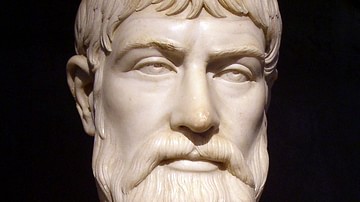
Pindar (c. 518 to c. 448/7 BCE) was an ancient Greek lyric poet, probably the greatest of his time. His works have been divided into 17 books of different types of poetry, but only those containing 44 choral victory songs composed for...

Definition
Thomas Aquinas
Saint Thomas Aquinas (l. 1225-1274, also known as the "Ox of Sicily" and the "Angelic Doctor") was a Dominican friar, mystic, theologian, and philosopher, all at once. Although he lived a relatively short life, dying at age 49...

Definition
Philolaus
Philolaus (l. c. 470 to c. 385 BCE) was a Pythagorean philosopher who claimed that fire was the first cause of existence and heat the underlying source of human life. He is best known for his pyrocentric model of the universe, which...
Definition
Grand Remonstrance
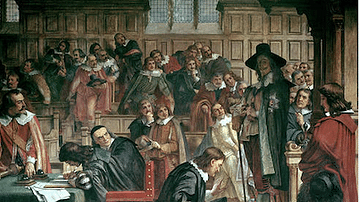
The Grand Remonstrance of 1641 was a list of grievances issued by Parliament against King Charles I of England (r. 1625-1649). It recorded what Parliament saw as the monarch's abuse of power, his illegal raising of taxes outside...

Definition
Ancient Afghanistan
The ancient history of Afghanistan, a landlocked country in Central Asia, is full of fascinating cultures, from early nomadic tribes to the realms of Achaemenid Persia, the Seleucids, the Mauryans, the Parthians, and Sasanians...
