
Search
Remove Ads
Advertisement
Search Results
Image
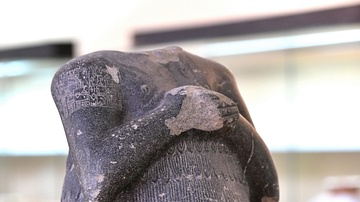
Headless Statue of Entemena of Lagash
This black diorite statue depictes Entemena, a king (or ruler) of Lagash, around 2400 BCE; identified by the cuneiform inscriptions on the right shoulder and back. The king wears the typical flounced Sumerian...

Article
Christianity in Japan
Christianity arrived in Japan in 1549 when Jesuits first set foot in Kagoshima. Initial attempts to spread the religion were met with confusion; however, through employing various methods, they began to see success. However...

Article
The Vikings in Iceland
The medieval sources on the discovery and settlement of Iceland frequently refer to the explorers as “Vikings” but, technically, they were not. The term “Viking” applies only to Scandinavian raiders, not to Scandinavians...

Article
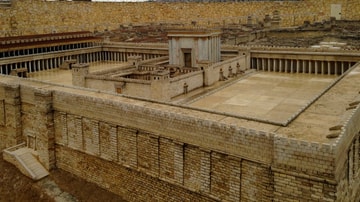
The Great Jewish Revolt of 66 CE
The Roman Empire in the early 1st century CE was often regarded as the perfect empire. The outstanding military prowess of the Romans was used to expand the empire, and once the territories were acceptably pacified...
Article
The Maccabean Revolt
The Maccabean Revolt of 167-160 BCE was a Jewish uprising in Judea against the repression of the Seleucid Empire. The revolt was led by a country priest called Mattathias, and his military followers became known as Maccabees...

Definition
Ancient Egyptian Government
The government of ancient Egypt was a theocratic monarchy as the king ruled by a mandate from the gods, initially was seen as an intermediary between human beings and the divine, and was supposed to represent the gods'...

Definition
Ancient Olympic Games
The ancient Olympic Games were a sporting event held every four years at the sacred site of Olympia, in the western Peloponnese, in honour of Zeus, the supreme god of the Greek religion. The games, held from 776 BCE to 393...
Definition
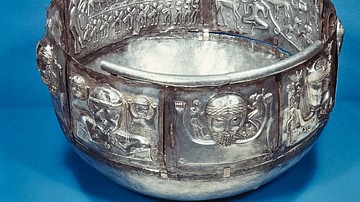
Gundestrup Cauldron
The Gundestrup Cauldron is a gilded silver bowl found in Gundestrup in Denmark in 1891 CE. It was likely made in the Balkans, perhaps in the 1st century BCE, and shows a clear influence from Celtic art and mythology, even if...
Definition
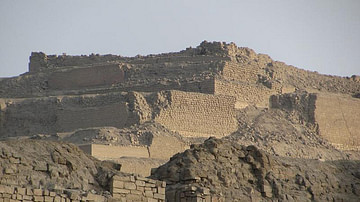
Pachacamac
Pachacamac, located on the coast of Peru and 32 km south of Lima, was an important sacred site, oracle, and place of burial, which was visited by pilgrims of many ancient Andean cultures, including the Incas. The site, active for...

Definition
Eleusis
Eleusis was a deme of Athens and most famous for its annual festival of the Mysteries in honour of Demeter and Persephone. The site was also an important fortress protecting Attica and held several other important festivals, notably...
