
Search
Remove Ads
Advertisement
Search Results

Definition
Richard, Duke of York
Richard, 3rd Duke of York (l. 1411-1460 CE) was the richest man in England and one of the nobles who sparked off the Wars of the Roses (1455-1487 CE), a dynastic dispute that rumbled on for four decades between several English...

Definition
Kim Yu-sin
Kim Yu-sin (aka Kim Yushin, 595-673 CE) was a general of the Silla kingdom which ruled south-eastern Korea during the Three Kingdoms Period. Kim would greatly help Silla unify Korea, famously leading a massive army to crush the rival...

Definition
Glorious Revolution
The Glorious Revolution of November 1688 saw Protestant William of Orange (l. 1650-1702) invade England and take the throne of Catholic James II of England (r. 1685-1688). There were no battles, and William was invited by Parliament...

Definition
First Battle of the Somme - Britain's Greatest Military Tragedy
The First Battle of the Somme took place in northern France during the First World War from 1 July to 18 November 1916. The battle (not to be confused with the Second Battle of the Somme, aka...

Definition
Battle of Agincourt
The Battle of Agincourt on 25 October 1415 saw Henry V of England (r. 1413-1422) defeat an overwhelmingly larger French army during the Hundred Year's War (1337-1453). The English won thanks to the superior longbow, field position...

Definition
Despotate of Epirus
The Despotate of Epirus was one of the successor states of the Byzantine Empire when it disintegrated following the Fourth Crusade's capture of Constantinople in 1204 CE. It was originally the most successful of those successor...
Definition
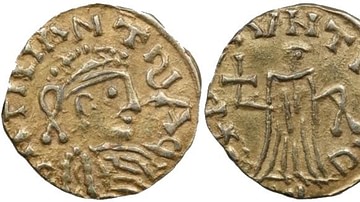
Guntram I of Orléans
Guntram I (also given as Gontrand, Gunthram, or Gunthchramn) was a Merovingian king who ruled over the Frankish kingdom of Orléans, later referred to as Burgundy, from 561 to 592. He often took on the role of mediator in the...

Definition
Roman Auxiliary Cavalry
The Roman army consisted of three separate divisions: the famed legions, the cavalry, and lastly, the auxiliaries. The auxiliaries (auxilia) were comprised of infantry cohorts, mounted infantry, and cavalry units or wings...

Definition
Roman Cavalry
Cavalry, although never replacing infantry as the mainstay of the Roman army, could provide useful cover on the flanks of armies, could be used as a shock tactic to cause disruption to enemy infantry formations, and could pursue...

Definition
Centurion
The centurion (centurio in Latin) was an officer in the Roman army whose experience and valour were a crucial factor in maintaining order on the battlefield and ensuring Rome's military successes spanned over centuries. A centurion...
