
Search
Remove Ads
Advertisement
Search Results

Definition
Tokugawa Iemitsu
Tokugawa Iemitsu (1604-1651) governed Japan as the third shogun of the Edo period. He implemented a number of important policies that not only consolidated his family's hold on power but also greatly impacted Japanese society...
Definition
Sogdiana
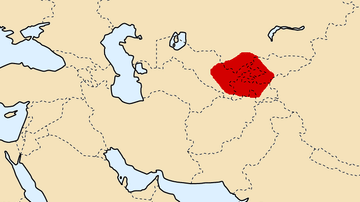
Sogdiana (or Sogdia) is a region in Central Asia between the mighty rivers Iaxartes in the north and Oxus in the south. Its eastern and western limits are more difficult to determine, especially since the toponym Sogdiana covered different...

Definition
Japanese Tea Ceremony
The Japanese Tea Ceremony (chanoyu or chado) is a cultural tradition involving very particular places, procedures, and equipment for drinking green tea. Originating as a habit of Chinese Buddhist monks to aid their meditation...

Definition
Dolmen
A dolmen is a megalithic structure typically formed from a large horizontal stone slab resting on two or more upright slabs. The oldest European examples are found in Brittany, northern France, and date to the 5th millennium BCE. Dolmens...

Definition
Scythian Warfare
Scythian warfare used state-of-the-art recurve bows and hit-and-run tactics against set infantry formations. Working from nimble horses, Scythian warriors could unleash a cloud of lethal arrows. Known, too, for their innovative...
Definition
Urdubegis
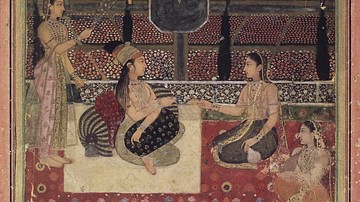
The urdubegis were a group of female warriors in the Mughal Empire, who protected the zenana, the harem of the emperor. Although the origins of female bodyguards go back to the beginning of Indian civilizations, the urdubegis were...

Definition
Mahabharata
The Mahabharata is an ancient Indian epic where the main story revolves around two branches of a family - the Pandavas and Kauravas - who, in the Kurukshetra War, battle for the throne of Hastinapura. Interwoven into this narrative...

Definition
Ancient Chinese Art
Ancient China covered a vast and ever-changing geopolitical landscape, and the art it produced over three millennia is, unsurprisingly, just as varied. Still, despite continuous indigenous technical developments, changes in...

Definition
Ancient Korean Coinage
The coinage of ancient Korea (pre-13th century CE) first employed Chinese coins, known locally as the oshuchon. Korean rulers began minting their own metal coins from the late 10th century CE, first in copper and iron, and...
Definition
Scythian Religion
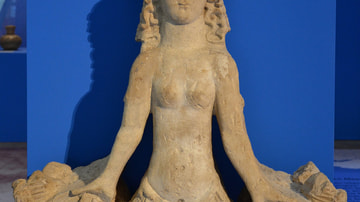
Scythian religion appears to be an amalgam of belief in a pantheon of gods grafted to more ancient animal reverence and shamanistic practice. According to their burial finds, the Scythians appear to have had a deep affinity with...
