
Search
Remove Ads
Advertisement
Search Results

Definition
Stupa
A stupa (literally “heap” or “pile”) is a reliquary, a shrine containing the remains of a holy or sainted person and/or artifacts (relics) associated with them, originating in India prior to the 5th century BCE as tombs of holy men and...

Definition
Silk in Antiquity
Silk is a fabric first produced in Neolithic China from the filaments of the cocoon of the silk worm. It became a staple source of income for small farmers and, as weaving techniques improved, the reputation of Chinese silk spread...

Curriculum Collection
AP World History Unit 1 - The Global Tapestry (c. 1200-1450)
Between 1200 and 1450 CE, no single power dominated the world. Instead, a number of powerful civilizations developed in parallel: the Song Dynasty in China, ruled after 1279 by the Mongols; the...

Article
Greco-Bactrian and Indo-Greek Kingdoms in Ancient Texts
The rarity of the appearance of Greco-Bactrian and Indo-Greek kingdoms in ancient literature is one of the reasons why those states are so little-known today. Indo-Greek literature did exist, but...

Article
Food & Agriculture in Ancient Japan
The diet of ancient Japan was heavily influenced by its geography as an archipelago, foodstuffs and eating habits imported from mainland Asia, religious beliefs, and an appreciation for the aesthetic appearance...

Article
Scythian Territorial Expanse
With 7600 perimeter miles (12,231 km), the Scythians roamed and ruled over an astonishing 1.5 million mi² (2.4 million km²) of territory between the 7th and 3rd centuries BCE. Although building an empire was never in...

Article
The Mongol Invasions of Japan, 1274 and 1281
The Mongol invasions of Japan took place in 1274 and 1281 CE when Kublai Khan (r. 1260-1294 CE) sent two huge fleets from Korea and China. In both cases, the Japanese, and especially the samurai warriors...

Article
Prehistoric Hunter-Gatherer Societies
Hunter-gatherer societies are – true to their astoundingly descriptive name – cultures in which human beings obtain their food by hunting, fishing, scavenging, and gathering wild plants and other edibles. Although...

Definition
Kofun Period
Following the Yayoi Period of Japan when farming and metalworking techniques were introduced from mainland Asia was the Kofun Period (c. 250 CE - 538 CE) where the religion of Shinto emerges from the beliefs of previous eras and...
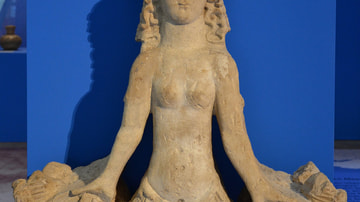
Definition
Scythian Religion
Scythian religion appears to be an amalgam of belief in a pantheon of gods grafted to more ancient animal reverence and shamanistic practice. According to their burial finds, the Scythians appear to have had a deep affinity with...
