
Search
Remove Ads
Advertisement
Search Results
Definition
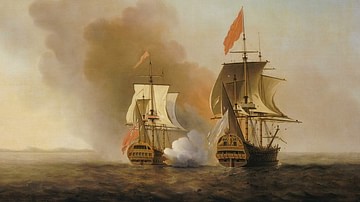
Galleon
The galleon (Spanish: galeón, French: galion) was a type of sailing ship used for both cargo carrying and as a warship. Galleons dominated the seas in the second half of the 16th century, and with their lower superstructures, they were...

Definition
Persian Wars
The Persian Wars refers to the conflict between Greece and Persia in the 5th century BCE which involved two invasions by the latter in 490 and 480 BCE. Several of the most famous and significant battles in history were fought during...

Definition
Pythagoras
Pythagoras (l.c. 571 to c. 497 BCE) was a Greek philosopher whose teachings emphasized the immortality and transmigration of the soul (reincarnation), virtuous, humane behavior toward all living things, and the concept of "number"...

Definition
Aria
Aria (or Areia) was always understood to be the area around the Areios River, today Hari Rud in Afghanistan (Arrian, Anabasis IV.6.6). It was bounded to the north by Margiana and Bactria, where the area of the Margos River begins; to the...

Definition
Battle of Gaugamela
The Battle of Gaugamela (1st October 331 BCE, also known as the Battle of Arbela) was the final meeting between Alexander the Great of Macedon and King Darius III of Persia. After this victory, Alexander was, without question...

Definition
Byzantium
The ancient city of Byzantium was founded by Greek colonists from Megara around 657 BCE. According to the historian Tacitus, it was built on the European side of the Strait of Bosporus on the order of the “god of Delphi” who said to...

Definition
Xerxes I
Xerxes I (l. 519-465, r. 486-465 BCE), also known as Xerxes the Great, was the king of the Persian Achaemenid Empire. His official title was Shahanshah which, though usually translated as `emperor', actually means `king of kings'. He...

Definition
Persian Immortals
The Ten Thousand Immortals were the elite force of the Persian army of the Achaemenid Empire (c. 550-330 BCE). They formed the king's personal bodyguard and were also considered the shock troops of the infantry in Persian warfare...

Article
Trade Goods of the East India Company
The English East India Company (EIC) was founded in 1600, and it came to control both trade and territories in India, as well as a trade monopoly with China. Goods the EIC traded included spices, cotton cloth...

Article
Mongol Multiculturalism
The Mongol Empire accepted and promoted many other cultures. Historians often talk about cultural exchange across Asia in the Mongol Empire as something that was just facilitated by peace and stability across such a huge...
