
Search
Search Results
Definition
Ancient Israelite Technology
Technology enabled ancient Israel, the Northern Kingdom excluding Judah, to be economically prosperous and establish itself as a major political power as early as the 10th century BCE, steadily growing until its destruction in 720 BCE. Some...

Definition
Tiglath Pileser III
Tiglath Pileser III (745-727 BCE) was among the most powerful kings of the Neo-Assyrian Empire and, according to many scholars, the founder of the empire (as opposed to the claims for Adad Nirari II (912-891 BCE) or Ashurnasirpal II (884-859...

Definition
Tiglath Pileser I
Tiglath Pileser I (reigned 1115-1076 BCE), an Assyrian king of the period known as the Middle Empire, revitalized the economy and the military that had been suffering, more or less, since the death of the king Tukulti Ninurta I (1244-1208...

Definition
War in Ancient Times
The word 'war' comes to English from the old High German language word Werran (to confuse or to cause confusion) through the Old English Werre (meaning the same), and is a state of open and usually declared armed conflict between political...

Definition
Tukulti-Ninurta I
Tukulti-Ninurta I (reigned 1244-1208 BCE) was a king of the Assyrian Empire during the period known as the Middle Empire. He was the son of Shalmaneser I (reigned 1274-1245 BCE) who had completed the work of his father, Adad Nirari I, in...
Definition
Adad Nirari I
Adad Nirari I (r. 1307-1275 BCE) was the king of the Assyrian Empire who initiated the first major expansion of the Assyrian kingdom from the city of Ashur throughout the region of Mesopotamia. He also instituted what would become standard...

Image
Balawat Gate at the British Museum
This is a full replica of one of the Balawat gates. The bronze bands are original and were embossed with warfare scenes and military campaigns conducted by the Assyrian King Shalmaneser III (e.g., the capture of Hamath and Hazuzu in Syria...

Article
Wall Reliefs: Ashurnasirpal II's War Scenes at the British Museum
The Mighty King 600 of their warriors I put to the sword and decapitated; 400 I took alive; 3,000 captives I brought forth; I took possession of the city for myself: the living soldiers, and heads to the city of Amidi the royal city, I sent...

Article
Winning Against the Odds: Sargon II & the Urartu Campaign
It is often when one is faced with the most difficult circumstances that one is given the greatest opportunity for clarity. History provides ample evidence of this experience in showing how, when faced with seemingly impossible situations...
Image
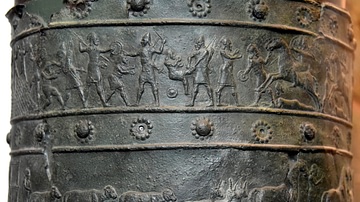
Slaughter of Urartians and Tribute from Gilzani
The upper register shows slaughter of Urartians with swords and bows while the lower register shows tribute of the men of Gilzani (rams, goats and horses). Shalmaneser III's military campaign in Armenia, c. 857 BCE. Detail, bronze band from...
