
Search
Remove Ads
Advertisement
Search Results
Image
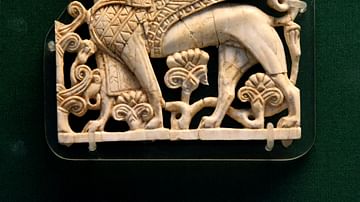
Nimrud Ivory Plaque of an Egyptian Sphinx
A winged human-headed sphinx wears the double crown of Egypt. An apron hangs down on the chest with a projecting uraeus (rearing cobra) similar to those worn by Egyptian pharaohs. A striking Phoenician style. Excavated by Sir Max Mallowan...
Image
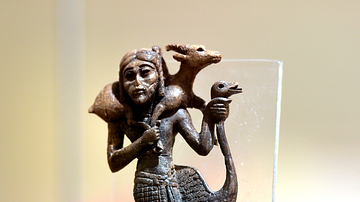
Ivory Figure of Syrian Man with an Ostrich & Goat, Nimrud
This burned ivory figure, carved in the round, depicts a male figure carrying a goat on his shoulders and holding an ostrich by the neck. The depiction is very realistic; the beak of the ostrich is opened and the front wing is held upwards...
Image
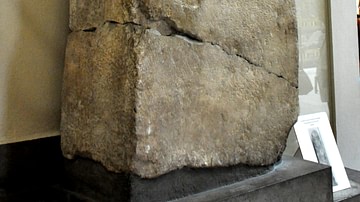
Stela of Queen Sammu-Ramat
Stela of Queen Sammu-Ramat from Assur (Ashur), northern Mesopotamia, modern-day Iraq. Neo-Assyrian Empire, c. 809 BCE. The cuneiform inscriptions on the upper part of the stela say that Sammu-ramat (or Shammuramat) is the wife (and palace...
Image
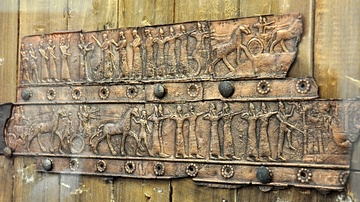
Embossed Scene from the Balawat Gate
Detail of the bronze casing of the Balawat gate. From Balawat (Imgur-Enlil), northern Mesopotamia, Iraq. Neo-Assyrian Period, reign of King Shalmaneser III, 858-824 BCE. (Ancient Orient Museum/Istanbul Archaeological Museums, Istanbul, Turkey...
Image
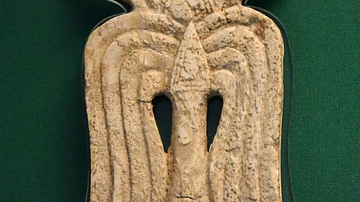
Nimrud Ivory Plaque of a Stylized Palm Tree
This ivory plaque shows a carving of a stylized palm tree. There are tenons at the top and bottom of the plaque. The overall depiction is very similar to a fragment found in Samaria (also housed in the Museum). Excavated by Sir Max Mallowan...

Image
Circular Stone Vessel From Tarbisu
A fragment of a circular stone vessel which was dedicated to the temple of God Nergal by a high official. The carved scenes in low relief depict the Assyrian king Shalmaneser III on his knees before a central object (lost), probably a sacred...
Image
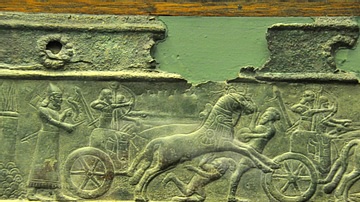
Detail of One of the Balawat Gates
Detail of the bronze casing of the Balawat gate. From Balawat (Imgur-Enlil), northern Mesopotamia, Iraq. Neo-Assyrian Period, reign of King Shalmaneser III, 858-824 BCE. (The British Museum, London)
Image
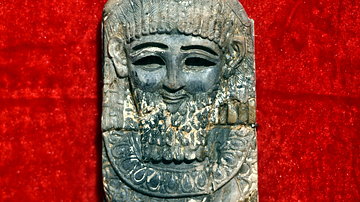
Ivory Sphinx from Nimrud
This ivory plaque is virtually complete but burnt (partly black and partly grey). It depicts the bearded head and forequarters of a sphinx, advancing left with head turned outwards. This is one of the rare examples of the combination of Syrian...

Image
A door socket from Anu-Adad Temple
The cuneiform inscriptions on this door socket mention the name of Shalmaneser III, King of Assyria (858-824 BCE). The king dedicated the stone to the gods Anu and Adad for his life and the well-being of his people. From Anu-Adad temple at...
Image
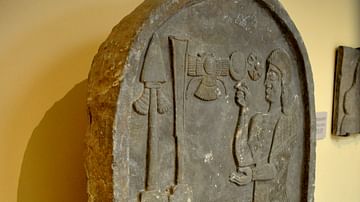
Stele of Bel-harran-beli-usur
Bel-harran-beli-usur was a high palace official (chamberlain) during the reign of the Assyrian kings Shalmaneser IV (782-773 BC) and Tigleth-Pileser III (744-727 BC). He built a city and a large temple to the west of Nineveh. The stele features...
