
Search
Remove Ads
Advertisement
Search Results
Image
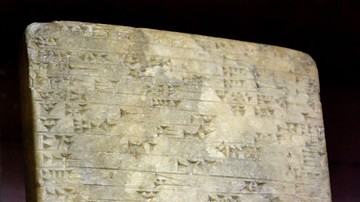
Stela of Shalmaneser I
Stone stela of the Assyrian king Shalmaneser I, reigned 1273-1244 BCE. The Akkadian inscription mentions how the king rebuilt one of the gateways at the city of Ashur. From Ashur, northern Mesopotamia, Iraq. Middle-Assyrian period. (The British...

Image
Two Statues of Shalmaneser III at the Iraq Museum
In the centre of this image is the so-called Kurba'il statue of Shalmaneser III (reigned 858-824 BCE), which was found in Fort Shalmaneser in 1961 CE by the British School of Archaeology in Iraq. The statue originally stood in the Temple...
![Throne Dais of Shalmaneser III [Front Panel]](https://www.worldhistory.org/img/c/p/360x202/10526.jpg?v=1733660592)
Image
Throne Dais of Shalmaneser III [Front Panel]
The front panel of this dais depicts Shalmaneser III (r. 858-824 BCE), (on the right) handshaking Marduk-zakir-shumi (r. 855 - 819 BCE) (left), king of Babylon. Both are surrounded by guards and stand below a fringed canopy supported by poles...
Image
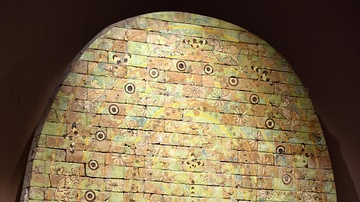
Glazed Wall Panel from Fort Shalmaneser
This large wall panel of vibrant glazed bricks was once placed above the entrance to a vast room (T3) next to Shalmaneser III's throne room at Fort Shalmaneser in Nimrud (in modern-day Nineveh Governorate, Iraq). The whole panel is composed...
Image
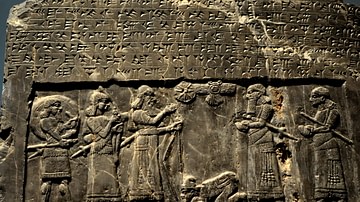
The Black Obelisk of Shalmaneser III, side A, upper register
The Assyrian king Shalmaneser III, holding a bow, receives a tribute from Sua the Gilzanean. The king faces his field marshal and another official.From Nimrud, (ancient Kalhu), near the building of Shalmaneser, neo-Assyrian era, 827 BCE...
Image
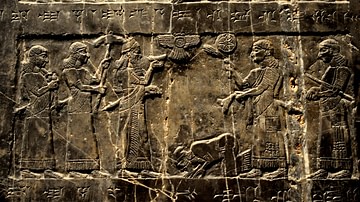
The Black Obelisk of Shalmaneser III, side A, 2nd register
The Assyrian king Shalmaneser III beneath a parasol, accepts the tribute from Iaua from the house of Humri in 841 BCE. This is king Jehu of Israel, who appears in the Bible (2 Kings 9-10). From Nimrud, (ancient Kalhu), near the building of...

Definition
Kalhu / Nimrud
Kalhu (also known as Caleh, Calah, and Nimrud, in modern-day northern Iraq) was a city in ancient Mesopotamia that became the capital of the Assyrian Empire under Ashurnasirpal II (r. 884-859 BCE) who moved the central government there from...

Definition
Sargon II
Sargon II (r. 722-705 BCE) was one of the most important kings of the Neo-Assyrian Empire as founder of the Sargonid Dynasty which would rule the empire for the next century until its fall. He was a great military leader, tactician, patron...
Image
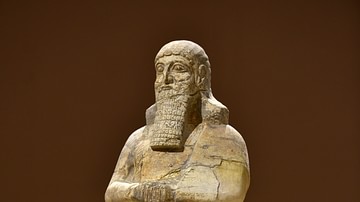
Kurba'il Statue of Shalmaneser III
Kurba'il statue of Shalmaneser III (r. 858-824 BCE), found in Fort Shalmaneser in 1961 by the British School of Archaeology in Iraq. The statue originally stood in the Temple of Adad at the city of Kurba'il, north of modern-day Mosul...
Image
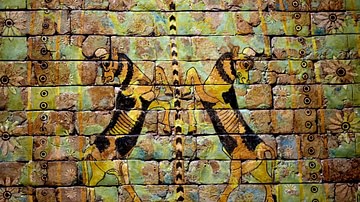
Glazed Wall Panel from Fort Shalmaneser
Detail of a large wall panel of vibrant glazed bricks once placed above the entrance to a vast room (T3) next to Shalmaneser III's throne room. The whole panel is composed of about 300 bricks and is 4 meters in length; this detail at the...
