
Search
Remove Ads
Advertisement
Search Results

Definition
Roman Religion
In many societies, ancient and modern, religion has performed a major role in their development, and the Roman Empire was no different. From the beginning Roman religion was polytheistic. From an initial array of gods and spirits...
Image
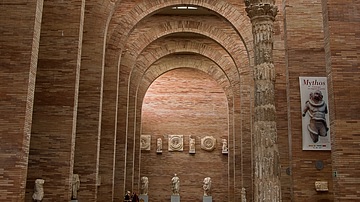
National Museum of Roman Art in Mérida, Spain
Main hall of the National Museum of Roman Art in Mérida (Spanish: Museo Nacional de Arte Romano), Spain. Inaugurated in 1986, the magnificent building, reflecting certain aspects of Roman architecture...

Definition
Abd al-Rahman I
Abd al-Rahman was the founder of the Emirate of Cordoba and ruled as Abd al-Rahman I from 756-788 CE. As one of the lone survivors of the Umayyad Dynasty after the Abbasids defeated the Umayyad Caliphate, Abd al-Rahman bridged...

Definition
Roman Empire
The Roman Empire, at its height (c. 117), was the most extensive political and social structure in western civilization. Building upon the foundation laid by the Roman Republic, the empire became the largest and most powerful political...
Image
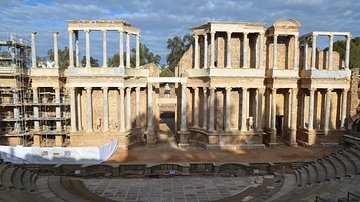
Roman Theatre of Augusta Emerita (Mérida, Spain)
The Roman theatre of Augusta Emerita is the most important Roman monument in Mérida (Spain) and the best example of its kind to be found in western Europe. Its construction began c. 15 BCE and an inscription...

Definition
Spanish Armada
The 1588 Spanish Armada was a fleet of 132 ships assembled by King Philip II of Spain (r. 1556-1598) to invade England, his 'Enterprise of England'. The Royal Navy of Elizabeth I of England (r. 1558-1603) met the Armada in the...

Definition
Abd al-Rahman III
Abd al-Rahman III was an Umayyad prince who reigned as Emir of Cordoba, and later Caliph of Cordoba, from 912 to 961 CE. His reign is remembered as a golden age of Muslim Spain and Umayyad rule, epitomized by his declaration...

Image
Roman Bridge of Córdoba, Spain
The Roman bridge of Córdoba is located in the Historic centre of Córdoba (declared a World Heritage Site in 1984), Andalusia, southern Spain. It was originally built in the early 1st century BCE across the Guadalquivir...
Image
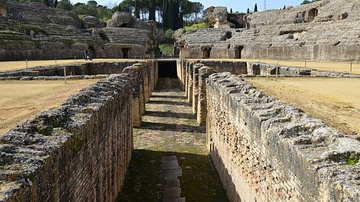
Roman Amphitheatre of Italica (Spain)
The Roman amphitheatre of Italica (located in modern-day Santiponce, 9 kilometres north of Seville in Spain) was one of the largest in the Empire, measuring 160 by 137 metres (525 by 450 feet). It was built during...
Image
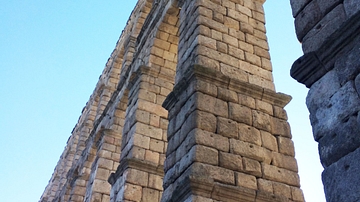
View of the Roman Aqueduct in Segovia, Spain
The Segovia Aqueduct was likely finished around the year 112 CE and once carried water from the Rio Frio situated 17 km (11 miles) from Segovia. It is one of Spain's cultural treasures, and it was listed...
