
Search
Remove Ads
Advertisement
Search Results

Image
Viceroyalty of New Spain, c. 1800
This map illustrates the Viceroyalty of New Spain, the earliest and most extensive administrative division of the Spanish Empire. At its peak, it encompassed a vast array of territories across North America, the...

Definition
Roman Empire
The Roman Empire, at its height (c. 117), was the most extensive political and social structure in western civilization. Building upon the foundation laid by the Roman Republic, the empire became the largest and most powerful political...

Definition
Buccaneer
The buccaneers were privateers who attacked enemies of their state, namely Spain, in the Caribbean and on the American coast (the Spanish Main) throughout the 17th century. Initially hunters and then seamen and soldiers, the buccaneers...

Article
Treasures of Roman Tunisia - 10 Key Sites Explored
Set on the North African coast, Tunisia is home to some of the finest Roman ruins in the Mediterranean. After the fall of Carthage, Rome transformed the region into the prosperous province of Africa...

Definition
Mauretania
Mauretania was an ancient kingdom in northwest Africa, encompassing regions of modern-day Morocco and Algeria. Although it shares a name with the modern country of Mauritania, they do not overlap. Ancient Mauretania was named after...

Definition
Roman Imperial Cult
The Roman imperial cult was the practice of venerating Roman emperors and their families as having divine attributes, honoring their contributions to the spread of Roman religion and culture. It was instituted by the first...

Definition
Roman Mythology
The ancient Romans had a rich mythology and, while much of it was derived from their neighbors and predecessors, the Greeks, it still defined the rich history of the Roman people as they eventually grew into an empire. Roman writers...
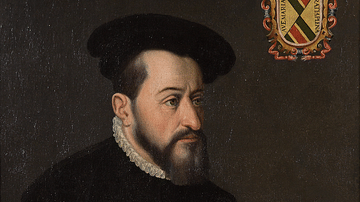
Image
Antonio de Mendoza, Viceroy of New Spain
A portrait of Antonio de Mendoza, the first viceroy of New Spain (Mexico and many surrounding territories) within the Spanish empire. He served from 1535 to 1550. (Museo Nacional de Historia, Mexico City)
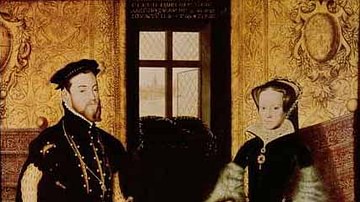
Image
Philip II of Spain & Mary I of England
A 1558 CE painting by Hans Eworth showing Philip II of Spain (r. 1556-1598 CE) and Mary I of England (r. 1553-1558 CE) who were married from 1554 CE until Mary's death in 1558 CE. (Woburn Abbey Collection, England...

Image
Philip II of Spain by Moro
A 16th century CE portrait by Giacomo Antonio Moro of Philip II of Spain (r. 1556-1598 CE).
