
Search
Remove Ads
Advertisement
Search Results

Image
Roman Coin with Soldiers
A Roman coin depicting two standing soldiers. Denarius of Caius Servilius, 1st century BCE. (Archaeological Museum, Tarragona, Spain)

Image
Roman Legionaries
This fragment of a Roman gravestone shows three legionaries. From Croy Hill, Scotland, 2nd century CE. (National Museum of Scotland, Edinburgh, UK)

Collection
Battles of the Roman Republic
In this collection we look at some of the most significant battles that shaped the history of the Roman Republic. There were defeats such as at Allia River to the Celts in 390 BCE or at Cannae in 216 BCE when the Carthaginians...

Collection
Battles of the Roman Empire
The Roman Empire was forged through warfare and in this collection we look at some of the key battles and revolts that shaped its borders from the reign of Augustus onwards. We look at Varus' shocking defeat at the Battle...

Article
The Battle of Philippi 42 BCE
The Battle of Philippi in 42 BCE was an all-Roman affair fought between the young Octavian, chosen heir of Julius Caesar, and the mercurial Mark Antony, widely regarded as the greatest living Roman general on the one...
Definition
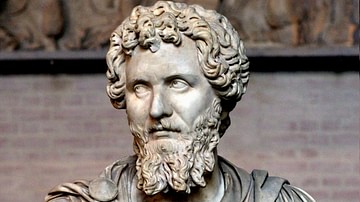
Septimius Severus
Lucius Septimius Severus was Roman emperor from April 193 to February 211 CE. He was of Libyan descent from Lepcis Magna and came from a locally prominent Punic family who had a history of rising to senatorial as well as consular...

Definition
Gaius Cassius Longinus - Liberator, Tyrannicide, or Traitor?
Gaius Cassius Longinus (circa 86-42 BCE) was a leader of the 'Liberators', the faction of Roman senators who assassinated Julius Caesar on the Ides of March (15 March) 44 BCE. Motivated by a...

Definition
Tiberius - The Reclusive Roman Emperor
Tiberius (42 BCE to 37 CE) was the second Roman emperor, who reigned from 14 to 37 CE. The adopted son of Augustus, he led a long and tormented life of service to the Roman Empire before becoming princeps (emperor...

Definition
Corpus Juris Civilis - The Justinian Law Code
The Justinian Code or Corpus Juris Civilis (Corpus of Civil Law) was a major reform of Byzantine law created by Emperor Justinian I (r. 527-565 CE) in 528-9 CE. Aiming to clarify and update the old Roman...

Definition
Praetor
A praetor was a senior magistrate in ancient Roman government, who was granted executive or imperium powers similar to that of the consuls. Although originally assigned legal authority over the courts, his executive powers allowed him...
