
Search
Remove Ads
Advertisement
Search Results
Image
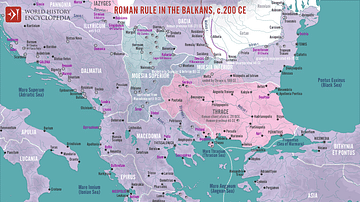
Roman Rule in the Balkans, c. 200 CE
A map illustrating Roman rule in the Balkans around 200 CE, characterized by significant administrative, military, and cultural integration into the Empire. The region was divided into several provinces (Moesia...

Image
Roman Blue-Glass Cinerary Urn from Luguvalium
Roman blue-glass cinerary urn, from Luguvalium (Botchergate, Carlisle), 1st century CE. Carlisle Cathedral. Burning the body after death and keeping the bones and ashes in the cineraria (funerary urns...

Video
Eros-Cupid and Psyche, the Greek and Roman Gods of Love and the Soul
Eros in Greek mythology, known as Cupid in Rome, is the god of love but more specifically, the god of physical and passionate desire. He is often referred to as a son and attendant of...

Image
The Five Good Emperors of the Roman Empire (96 - 180 CE)
This infographic illustrates the succession of Roman emperors from 96 to 180 CE, commonly referred to as the Five Good Emperors - Nerva, Trajan, Hadrian, Antoninus Pius, and Marcus Aurelius. This...
Definition
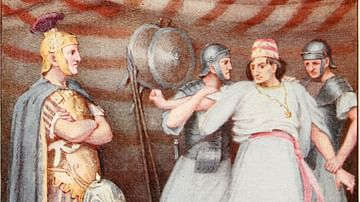
Jugurtha
Jugurtha (r. 118-105 BCE) was King of Numidia in North Africa and grandson of the first Numidian king Masinissa (r. c. 202-148 BCE). He was the illegitimate son of Mastanabal, Masinissa's youngest son, and was the least likely of Masinissa's...

Definition
Hilda of Whitby
Hilda of Whitby (also known as Saint Hilda of Whitby, l. 614-680 CE) was the founder and abbess of the monastery at Whitby, Kingdom of Northumbria, Britain. She was a Northumbrian princess who converted to Christianity with the...
Definition
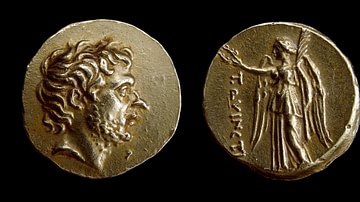
Titus Quinctius Flamininus
Titus Quinctius Flamininus (229-174 BCE) was a consul and military commander of the Roman Republic during the Second Macedonian War, who decisively defeated Philip V of Macedon (r. 221-179 BCE) at the Battle of Cynoscephalae...

Definition
Amphitheatre - The Roman Contribution to Public Architecture
An amphitheatre was a structure built throughout the Roman empire where ordinary people could watch such spectacles as gladiator games, mock naval battles, wild animal hunts, and public executions...

Definition
Berbers
The Berbers have occupied North Africa, specifically the Maghreb, since the beginning of recorded history and until the Islamic conquests of the 8th century CE constituted the dominant ethnic group in the Saharan region. Modern Berber...

Definition
Byzantium
The ancient city of Byzantium was founded by Greek colonists from Megara around 657 BCE. According to the historian Tacitus, it was built on the European side of the Strait of Bosporus on the order of the “god of Delphi” who said to...
