
Search
Remove Ads
Advertisement
Search Results

Definition
Leonidas I of Sparta
Leonidas was the Spartan king who famously led a small band of Greek allies at the Battle of Thermopylae in 480 BCE where the Greeks valiantly defended the pass through which the Persian king Xerxes sought to invade Greece...
Definition
Pausanias (General)
Pausanias (c. 510 - c. 465 BCE) was a Spartan regent and general who won glory by leading a combined Greek force to victory over the Persians at the Battle of Plataea in 479 BCE. Famously immodest regarding his own talent...

Definition
Leprechaun
Leprechauns (also leprecauns or lepracauns) are figures in Irish folklore who guard hidden treasure. Regarded as small and incredibly agile male fairies or goblins, they most often guard a pot of gold. Leprechauns live solitary lives...

Video
Creation from the Void: Crash Course World Mythology #2
Today on Crash Course Mythology we’re starting in on creation stories. This week, we’ll focus on the creation of the universe out of nothing, or Ex Nihlio creation. Basically, a god decides to make...

Article
Cats in the Ancient World
Cats and humans have shared in each other's lives for thousands of years and, even though they have not always been regarded as highly as in the present, have played an important role in a number of cultures. Always enigmatic...

Video
9 Notorious Creatures from Slavic Folklore - Slavic Mythology
These are the most notorious Slavic creatures from the Slavic Mythology. Creatures from the Slavic Folklore found in this video: Kikimora - an evil spirit that enters the house. Domovoi...

Definition
Zephyrus
Zephyrus was the god of the west wind and the messenger of spring in Greek mythology. He was known as one of the four Anemoi, or wind gods, each of whom represented a cardinal direction and, except for Eurus, a season. Zephyrus was...

Definition
Ur - The Great Biblical City Abandoned by the Gods
Ur was a city in the region of Sumer, in southern Mesopotamia, and its ruins lie in what is modern-day Tell el-Muqayyar, Iraq. According to biblical tradition, the city is named after the man who founded...

Video
The Valkyries - Norse Mythology
Norse Mythology: The Valkyries
This video is a concise overview & history of the Nordic Mythological beings, Valkyries.
Voice: Michael Nakhiengchanh
Image
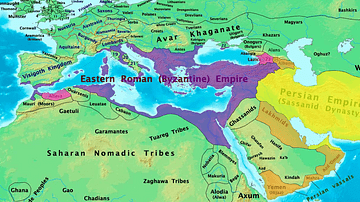
Byzantine & Persian Empires in the 7th Century
A map showing the extent of the Byzantine Empire and the Sasanian Empire in the 7th century.
