
Search
Remove Ads
Advertisement
Search Results

Video
Top 5 Facts - The Persian Empire
Highway guards, King assassinations and cat soldiers? Heres 5 things you didn’t know about the Persian Empire. For more historical facts and features, visit http://www.historyanswers.co.uk/ Or purchase the...

Definition
Pasiphaë
Pasiphaë ("all-shining") is the wife of King Minos of Crete and the mother of the fearsome Minotaur (half-bull, half-man creature) in Greek mythology. She is the daughter of the sun god Helios and Perse, an Oceanid. Like her sister...

Definition
Edda
Edda is a term used to describe two Icelandic manuscripts that were copied down and compiled in the 13th century CE. Together they are the main sources of Norse mythology and skaldic poetry that relate the religion, cosmogony, and history...

Definition
Frigg
Frigg is a fertility goddess in Norse mythology. She is the wife of Odin, king of the gods, and is the greatest goddess of the Norse pantheon. She is thought to have developed, along with the goddess Freyja, from an earlier fertility...

Definition
Charon - The Ferryman to the Dead in Greek Mythology
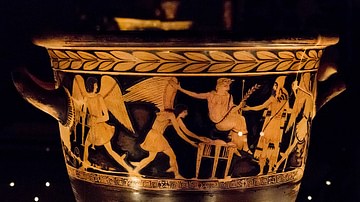
Charon is a figure from Greek mythology where he is the boatman who ferries the souls of the dead across the waters of Hades to the judgement which will determine their final resting place. The Greeks...
Definition
Harpy
A harpy, also known as a harpyia (pl. harpyiai), is a part-bird, part-woman monster in Greek mythology. Known as the 'Hounds of Zeus,' they were the personification of storm winds and were under the command of Zeus, who would send them...

Definition
Nyx
Nyx (also known as Nox or the Night) is the personification of the night in Greek mythology. Coming from Chaos (Void), Nyx is a primordial deity (Protogenoi). The Protogenoi represent the physical and elemental forces of the world and consist...

Video
Enlil - The God of Storms - Sumerian Mythology
Enlil is the god of air, wind, and storms in Sumerian mythology. The son of Anu, he was responsible for separating heaven and earth and organizing the universe. For his deeds, he became the chief of the...

Article
Cultural Links between India & the Greco-Roman World
Cyrus the Great (558-530 BCE) built the first universal empire, stretching from Greece to the Indus River. This was the famous Achaemenid Empire of Persia. An inscription at Naqsh-i-Rustam, the tomb...
Definition
Pindar
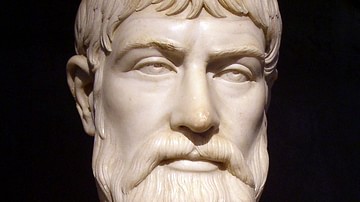
Pindar (c. 518 to c. 448/7 BCE) was an ancient Greek lyric poet, probably the greatest of his time. His works have been divided into 17 books of different types of poetry, but only those containing 44 choral victory songs composed for...
