
Search
Remove Ads
Advertisement
Search Results

Definition
Amber in Antiquity
Amber, the fossilised resin of trees, was used throughout the ancient world for jewellery and decorative objects. The main source was the Baltic region where amber, known to mineralogists as succinite, was washed up onto beaches...

Definition
Karakorum - Capital of the Mongol Empire
Karakorum (aka Qaraqorum, modern name: Harhorin) is located in the Orkhon Valley of central Mongolia and was the capital of the Mongol Empire from 1235 to 1263. Ogedei Khan (r. 1229-1241) ordered its construction...

Definition
John Cabot
John Cabot (aka Giovanni Caboto, c. 1450 - c. 1498 CE) was an Italian explorer who famously visited the eastern coast of Canada in 1497 CE and 1498 CE in his ship the Mathew (also spelt Matthew). Sponsored by Henry VII of England...

Definition
Parthian Religion
Parthian religion might be best described with two words: inclusive and evolving. As Parthia's empire held within it a variety of cultures, the Parthians wisely left each to their own beliefs and traditions, like the Seleucid...

Definition
Pre-Colonial North America
Pre-Colonial North America (also known as Pre-Columbian, Prehistoric, and Precontact) is the period between the migration of the Paleo-Indians to the region between 40,000-14,000 years ago and contact between indigenous...

Definition
Flour War
The Flour War refers to the series of approximately 300 riots that swept through France from April to May 1775, because of rising bread prices. The revolts only subsided after soldiers had been deployed, resulting in hundreds of arrests...

Definition
Council of the Indies
The Council of the Indies (El Real y Supremo Consejo de las Indias) operated from 1524 to 1834 and was the supreme governing body of the Spanish Empire in the Americas and Spanish East Indies. Reporting directly to the monarch...
Definition
Zarathustra
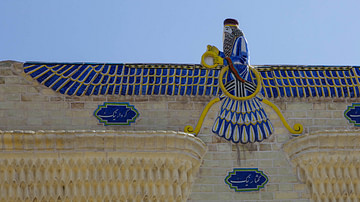
Zarathustra (also given as Zoroaster, Zartosht, Zarathustra Spitama, l. c. 1500-1000 BCE) was the Persian priest-turned-prophet who founded the religion of Zoroastrianism (also given as Mazdayasna “devotion to Mazda”), the first monotheistic...

Definition
Minoan Art
The art of the Minoan civilization of Bronze Age Crete (2000-1500 BCE) displays a love of animal, sea, and plant life, which was used to decorate frescoes and pottery and also inspired forms in jewellery, stone vessels, and sculpture...

Definition
Neo-Assyrian Empire
The Neo-Assyrian Empire (912-612 BCE) was the final stage of the Assyrian Empire, stretching throughout Mesopotamia, the Levant, Egypt, Anatolia, and into parts of Persia and Arabia. Beginning with the reign of Adad Nirari...
