
Search
Did you mean: Aedile?
Remove Ads
Advertisement
Search Results

Definition
Roman Warfare
Roman warfare was remarkably successful over many centuries and across many territories. This was due to several important factors. Italy was a peninsula not easily attacked, there was a huge pool of fighting men to draw upon, a...

Definition
George Frideric Handel
George Frideric Handel (1685-1759) was a composer of baroque music who was born in Germany but became an English citizen. His most famous works include his Messiah, Water Music, baroque Italian operas, and English oratorios...

Definition
Florentine Codex - An Encyclopedia of Life in 16th-Century Mexico
The Florentine Codex is an encyclopedic accounting of life in 16th-century Mexico and an invaluable resource for understanding the exchange between European and Indigenous cultures during...

Definition
Roman Medicine
Roman medicine was greatly influenced by earlier Greek medicine and literature but would also make its own unique contribution to the history of medicine through the work of such famous experts as Galen and Celsus. Whilst there...

Definition
Anne of Austria
Anne of Austria (1601-1666), as the wife of King Louis XIII of France (r. 1610-1643), was queen consort of France and of Navarre when the Kingdom of Navarre was annexed by the French Crown. She also acted as regent for her son...

Definition
Château de Chambord
The Chateau de Chambord, located in the Loire Valley of Loir-et-Cher, France, was built between 1519 and 1547 CE. This fine French Renaissance building, although impressive in both size and architectural detail, was commissioned...

Definition
Paolo Uccello
Paolo Uccello (1397-1475 CE), real name Paolo di Dono, was an Italian painter who is considered one of the founding fathers of Florentine Renaissance art. Uccello was one of the earliest artists to attempt certain tricks of perspective...

Definition
Antoine de Chandieu
Antoine de Chandieu (l. 1534-1591) was a French theologian, who played a decisive role in the religious history of the 16th century but remains in the shadow of other French Protestant leaders. Due to his remarkable abilities...
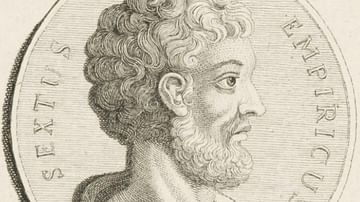
Definition
Sextus Empiricus
Sextus Empiricus (l. c. 160 to c. 210 CE) was a Greek Skeptic who developed the ideas of the earlier Greek Skeptic philosopher Pyrrho of Elis (l. c. 360 to c. 270 BCE) who claimed that tranquility of mind was attainable by suspending...

Curriculum Collection
AP European History Unit 1 - Renaissance and Exploration (c. 1450 to c. 1648)
Between roughly 1450 and 1648, Europeans both changed their view of the world and their place in it. Humanists in the Italian city-states revived the study of classical literature...
