
Search
Remove Ads
Advertisement
Search Results

Definition
Herodotus
Herodotus (l. c. 484 – 425/413 BCE) was a Greek historian famous for his work Histories. He was called The Father of History by the Roman writer Cicero, who admired him, but has also been rejected as The Father of Lies by critics...

Definition
Persian Wars
The Persian Wars refers to the conflict between Greece and Persia in the 5th century BCE which involved two invasions by the latter in 490 and 480 BCE. Several of the most famous and significant battles in history were fought during...

Definition
Croesus
Croesus (r. 560-546 BCE) was the King of Lydia, a region in western Asia Minor (modern-day Turkey) and was so wealthy that the expression "as rich as Croesus" originates in reference to him. Best known for his wealth, he is also famous...

Definition
Despotate of Epirus
The Despotate of Epirus was one of the successor states of the Byzantine Empire when it disintegrated following the Fourth Crusade's capture of Constantinople in 1204 CE. It was originally the most successful of those successor...

Definition
Anaxagoras
Anaxagoras (l. c. 500-c. 428 BCE) was a Pre-Socratic Greek philosopher who claimed the First Cause of existence was Mind (nous) and all things were constituted of indestructible “seeds” (or “stuff”), originally a single mass, separated...
Definition
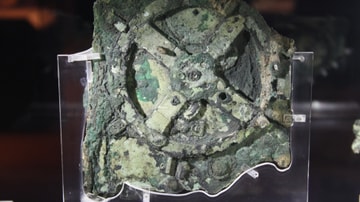
Antikythera Mechanism
The Antikythera mechanism (also known as the Antikythera Device), dated to the late 2nd century/early 1st century BCE (roughly 205-60 BCE) is understood as the world's first analog computer, created to accurately calculate...
Definition
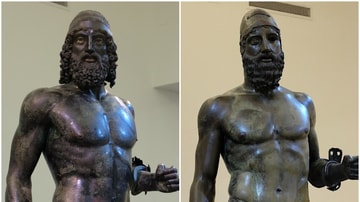
Riace Bronzes
The Riace Bronzes, also known as the Riace Warriors, are a pair of bronze statues most likely sculpted in Greece in the mid-5th century BCE and rescued from the Ionian Sea near Riace Marina, Italy in 1972 CE. Slightly larger than...

Definition
Cleisthenes
Cleisthenes (b. late 570s BCE) was an Athenian statesman who famously reformed the political structure and processes of Athens at the end of the 6th century BCE and, thereby, greatly increased the influence of ordinary citizens on...

Definition
Acropolis
An acropolis is any citadel or complex built on a high hill. The name derives from the Greek akro, "high" or "extreme/extremity" or "edge", and polis, "city", translated as "high city", "city on the edge" or "city in the air", the...

Definition
Athens
Athens, Greece, with its famous Acropolis, has come to symbolize the whole of the country in the popular imagination, and not without cause. It not only has its iconic ruins and the famous port of Piraeus but, thanks to ancient writers...
