
Search
Remove Ads
Advertisement
Search Results

Definition
Tiglath Pileser III
Tiglath Pileser III (745-727 BCE) was among the most powerful kings of the Neo-Assyrian Empire and, according to many scholars, the founder of the empire (as opposed to the claims for Adad Nirari II (912-891 BCE) or Ashurnasirpal...
Definition
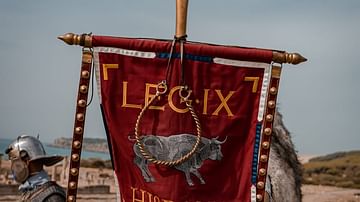
Legio IX Hispana
Legio IX Hispana served with Julius Caesar in Gaul and against Pompey in the Civil Wars. Later, it fought alongside Augustus in his Cantabrian Wars and was one of the four legions Claudius took with him in his invasion of Britain...

Definition
Vespasian - The Commoner Who Became Roman Emperor
Vespasian (9-79 CE) was Roman emperor from 69 to 79 CE. Despite his low birth, he worked hard to rise through the ranks of Roman politics and eventually achieved prominence as a military commander. He...

Definition
Late Period of Ancient Egypt - The End of Egyptian Rule of Egypt
The Late Period of Egypt (525-332 BCE) is the era following the Third Intermediate Period (1069-525) and preceding the brief Hellenistic period (332-323 BCE) when Egypt was ruled by the Argead...

Definition
War in the Vendée
The War in the Vendée was a counter-revolutionary uprising that took place in the Vendée department of France from 1793 to 1796, during the French Revolution (1789-99). In response to the French Republic's attempts to impose...

Definition
Transatlantic Slave Trade - The Shame of Nations
The transatlantic slave trade (also given as the Atlantic slave trade, circa 1492 to 1860) was the practice of enslaving the citizens of African states and transporting them across the Atlantic Ocean to...

Article
Legions of Mesopotamia, Cappadocia, & Arabia
As the Roman Empire expanded further eastward, annexing territories that were once the domain of the Parthians, the legions of Mesopotamia, Cappadocia, and Arabia were called upon to safeguard these newly...

Definition
Manorialism
Medieval European Manorialism (Manorial System) was the system where rural society was arranged around a manor house or castle on an estate. The smallest units of these estates were called manors. Free and unfree labourers here worked...

Definition
Serf
Medieval serfs (aka villeins) were unfree labourers who worked the land of a landowner (or tenant) in return for physical and legal protection and the right to work a separate piece of land for their own basic needs. Serfs made up 75%...

Definition
John Wycliffe
John Wycliffe (l. 1330-1384, also John Wyclif) was an English theologian, priest, and scholar, recognized as a forerunner to the Protestant Reformation in Europe. Wycliffe condemned the practices of the medieval Church, citing many...
