
Search
Remove Ads
Advertisement
Search Results
Definition
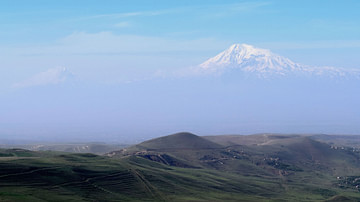
Mount Ararat
Mount Ararat (Armenian: Masis; Turkish: Ağrı Dağı; Kurdish: Çiyaye Agiri; Azeri: Ağrıdağ; Persian: Kūh-e Nūḥ) is a dormant, compound volcanic mountain, consisting of two ancient volcanic peaks, located in present-day eastern Turkey...

Definition
Tokugawa Iemitsu
Tokugawa Iemitsu (1604-1651) governed Japan as the third shogun of the Edo period. He implemented a number of important policies that not only consolidated his family's hold on power but also greatly impacted Japanese society...

Definition
Chikamatsu Monzaemon
Chikamatsu Monzaemon (1653-1725) was a Japanese playwright who wrote for both the puppet theatre and kabuki. He is regarded as Japan’s greatest dramatist. Apart from their aesthetic appeal, his plays are of value because they...

Definition
Sardis
Sardis (near modern-day Sart, Turkey) was the capital of the ancient Kingdom of Lydia founded (according to Herodotus) by the Heracleidae, the Heraclid Dynasty descended from the hero Heracles (Hercules). The city was famous in antiquity...

Definition
Shapur I
Shapur I (r. 240-270 CE) is considered one of the greatest kings of the Sassanian Empire for expanding his realm, his policy of religious tolerance, building projects, and committing the Zoroastrian scriptures (Avesta) to writing. He...

Definition
Hadrian
Hadrian (l. 78-138 CE) was emperor of Rome (r. 117-138 CE) and is recognized as the third of the Five Good Emperors (Nerva, Trajan, Hadrian, Antoninus Pius, and Marcus Aurelius) who ruled justly. His reign marked the height of the Roman...

Definition
Ancient Scotland
Scotland is a country which, today, comprises the northern part of Great Britain and includes the islands known as the Hebrides and the Orkneys. The name derives from the Roman word "Scotti" which designated an Irish tribe who...

Definition
Ancient Egyptian Mythology
Egyptian mythology was the belief structure and underlying form of ancient Egyptian culture from at least c. 4000 BCE (as evidenced by burial practices and tomb paintings) to 30 BCE with the death of Cleopatra VII, the...

Definition
Lao-Tzu
Lao-Tzu (l. c. 500 BCE, also known as Laozi or Lao-Tze) was a Chinese philosopher credited with founding the philosophical system of Taoism. He is best known as the author of the Laozi (later retitled the Tao-Te-Ching translated as “The...

Definition
Maya Religion
Maya religious beliefs are formed on the notion that virtually everything in the world contains k'uh, or sacredness. K'uh and k'uhul, similar terms which are used to explain the spirituality of all inanimate and animate things...
