
Search
Remove Ads
Advertisement
Search Results

Definition
Kosrau I
Kosrau I (r. 531-579 CE) was the greatest king of the Sassanian Empire (224-651 CE) in virtually every aspect of his reign. He reformed the military, the Persian government, expanded his territories, engaged in large-scale building...

Definition
Yin and Yang
The principle of Yin and Yang from Chinese philosophy is that all things exist as inseparable and contradictory opposites. Examples of Yin-Yang opposite forces are female-male, dark-light, and old-young. The pairs of equal opposites...

Definition
Aztec Civilization - The Last Mesoamerican Empire
The Aztec Empire (c. 1345-1521) covered at its greatest extent most of northern Mesoamerica. Aztec warriors were able to dominate their neighbouring states and permit rulers such as Montezuma to impose...
Definition
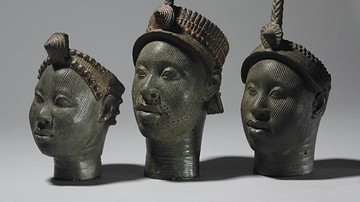
Ife
Ife (aka Ile-Ife) was an ancient African city which flourished between the 11th and 15th century CE in what is today Nigeria in West Africa. Ife was the capital and principal religious centre of the Yoruba kingdom of Ife, which prospered...

Definition
Nile
The world's longest river, located in Egypt, the Nile flows 4,132 miles (6,650 kilometres) northward to the Mediterranean Sea (a very unusual direction for a river to take). It was considered the source of life by the ancient Egyptians...

Definition
Apophis
Apophis (also known as Apep) is the Great Serpent, enemy of the sun god Ra, in ancient Egyptian religion. The sun was Ra's great barge which sailed through the sky from dawn to dusk and then descended into the underworld. As it sailed...

Definition
Hanging Gardens of Babylon
The Hanging Gardens of Babylon were the fabled gardens which beautified the capital of the Neo-Babylonian Empire, built by its greatest king Nebuchadnezzar II (r. 605-562 BCE). One of the Seven Wonders of the Ancient World...

Article
Death and the Afterlife in Ancient Persia
A vision of the afterlife is articulated by every culture, ancient or modern, in an effort to answer the question of what happens after death. Ancient Persia had the same interest in this as any culture of...

Definition
Christopher Columbus
Christopher Columbus (l. 1451-1506 CE, also known as Cristoffa Corombo in Ligurian and Cristoforo Colombo in Italian) was a Genoese explorer (identified as Italian) who became famous in his own time as the man who discovered...
Definition
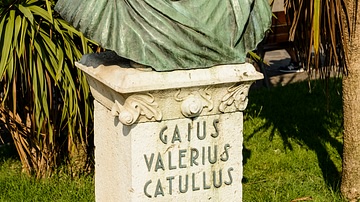
Catullus
Gaius Valerius Catullus (84-54 BCE) was a Roman poet whose poems are considered to be some of the finest examples of lyric poetry from ancient Rome, despite his youth and early death. Catullus wrote in the neoteric style during the...
