
Search
Remove Ads
Advertisement
Search Results
Image
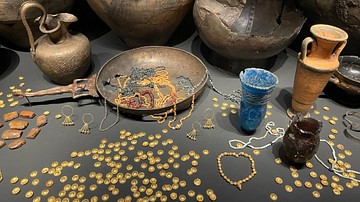
Treasures from a Woman's Burial in Vani
Grave goods from the richest burial at Vani (located in the Imereti region of Georgia), dated to about 450 BCE. Grave 11, contained four bodies inside a wooden structure: a woman, distinguished by the richness...
Image
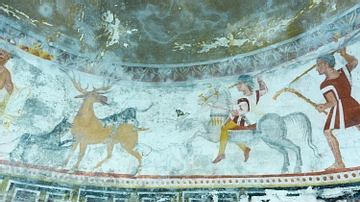
Painted Burial Chamber, Haskovo
A detail of a painted dromos and dome camera from a tumulus near Aleksandrovo village, Haskovo district, Bulgaria. The dromos has battle scenes while the burial chamber has a hunting scene, unfolded in a circle, and...
Image
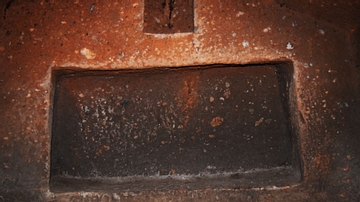
Urartian Burial Niche at Agarak
This is an ancient Urartian burial niche, which was found at Agarak, Armenia. It dates from the 8th-7th centuries BCE.
Image
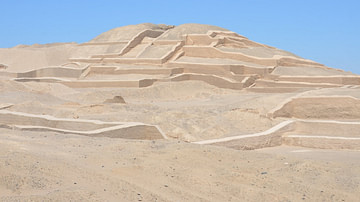
Burial Mound, Cahuachi
A burial mound at the Nazca site of Cahuachi, southern Peru. The 40 mounds at the site are built on natural hilltops using earth and adobe-brick retaining walls. The site was used for burials and religious ceremonies between...
Image
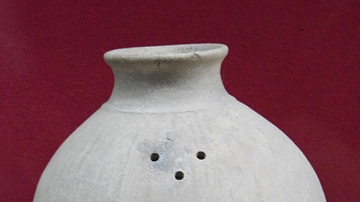
Urartian Burial Urn
This burial urn was discovered near the ancient Erebuni Fortress. It dates from the 8th century BCE and is made from baked clay. (Erebuni Historical and Archaeological Preserve, Yerevan, Armenia.)
Image
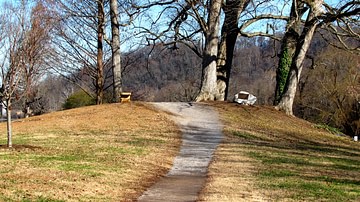
Cherokee Burial Mound
Native American burial mound, associated with the Cherokee nation, in the Cherokee Boulevard median of Knoxville, Tennessee, USA. The plaque on the rock reads: This mound was constructed by Native Americans between A.D. 900-1100...
Image
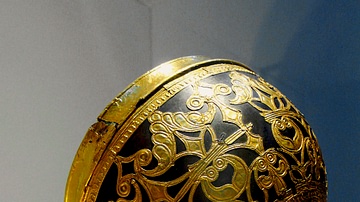
Celtic Bowl, Schwarzenbach Burial
A Celtic bowl with embossed gold leaf decoration from the princely burial at Schwarzenbach, Rhineland, Germany. 5th century BCE. (Staatliche Museen zu Berlin)
Image
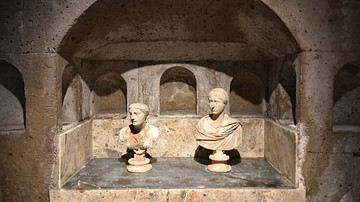
The Weiden Burial Chamber
The Weiden burial chamber, Colonia Agrippina, (Cologne, Germany), dated to the 2nd-4th century CE.
Image
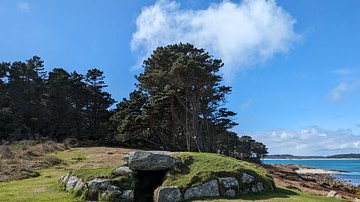
Upper Innisidgen Burial Chamber
This burial mound is found on the island of St. Mary's in the Isles of Scilly. This cairn is well-preserved with a substantial mound, a stone berk, and an intact inner chamber. Its precise date of construction is still...
Image
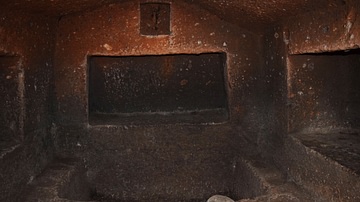
Urartian Burial Niche Interior at Agarak
This is a picture of an ancient Urartian burial niche at the Agarak archaeological site in what is present-day Armenia. It dates from roughly the 8th or 7th century BCE.
