
Search
Remove Ads
Advertisement
Search Results

Definition
Ancient Scotland
Scotland is a country which, today, comprises the northern part of Great Britain and includes the islands known as the Hebrides and the Orkneys. The name derives from the Roman word "Scotti" which designated an Irish tribe who...
Definition
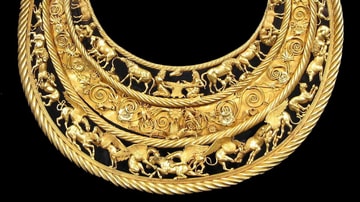
Scythian Art
Scythian art is best known for its 'animal art.' Flourishing between the 7th and 3rd centuries BCE on the steppe of Central Asia, with echoes of Celtic influence, the Scythians were known for their works in gold. Moreover, with the...

Definition
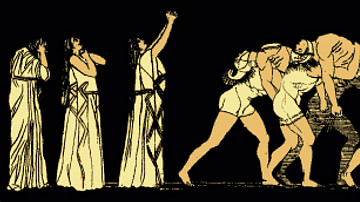
Ajax (Play)
Ajax is a play written by the 5th-century BCE Greek poet and dramatist Sophocles. Although Sophocles wrote at least 120 plays, only seven have survived. Of his surviving plays, the best-known is Oedipus Rex (Oedipus the King) - part...
Definition
Suppliants by Euripides
The Suppliants (also given as Suppliant Women) is a Greek tragedy written by Euripides, not to be confused with Aeschylus' tragedy of the same title. Its exact date of production is not known, possibly around 424 to 420...

Definition
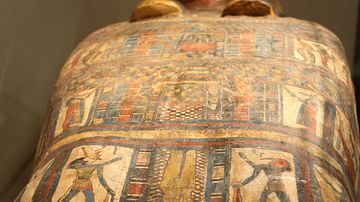
Anubis
Anubis (also known as Inpu, Inpw, Anpu) is the Egyptian god of mummification, funerary rites, guardian of tombs, and guide to the afterlife as well as the patron god of lost souls and the helpless. He is one of the oldest gods of Egypt...
Definition
Qebhet
Qebhet (also known as Kebehwet, Kabechet or Kebechet) is a benevolent goddess of ancient Egypt. She is the daughter of the god Anubis, granddaughter of the goddess Nephthys and god Osiris, and is the personification of cool, refreshing...

Article
Daily Life in Ancient Egypt
The popular view of life in ancient Egypt is often that it was a death-obsessed culture in which powerful pharaohs forced the people to labor at constructing pyramids and temples and, at an unspecified time, enslaved...

Article
Ancient Mesopotamian Beliefs in the Afterlife
Unlike the rich corpus of ancient Egyptian funerary texts, no such “guidebooks” from Mesopotamia detail the afterlife and the soul's fate after death. Instead, ancient Mesopotamian views of the afterlife...

Article
Scythian Territorial Expanse
With 7600 perimeter miles (12,231 km), the Scythians roamed and ruled over an astonishing 1.5 million mi² (2.4 million km²) of territory between the 7th and 3rd centuries BCE. Although building an empire was never in...
Article
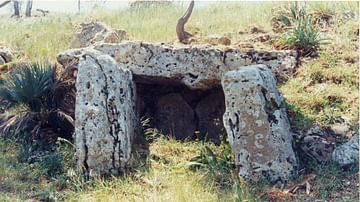
The Dolmens of Sicily
It is a well-known fact that Sicily, the largest island in the Mediterranean sea, went through a quite complex prehistoric period. So much so that it is difficult to navigate through the muddle of people that have followed...
