
Search
Remove Ads
Advertisement
Search Results

Definition
Wu Zetian
Empress Wu Zetian (Empress Consort Wu, Wu Hou, Wu Mei Niang, Mei-Niang, and Wu Zhao, l. 624-705 CE, r. 690-704 CE) was the only female emperor of Imperial China. She reigned during the Tang Dynasty (618-907 CE) and was one of the most...
Definition
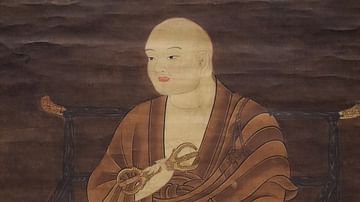
Kukai - Japan's Founder of Shingon Buddhism
Kukai or Kobo Daishi (774-835 CE) was a scholar, poet, and monk who founded Shingon Buddhism in Japan. The monk became the country's most important Buddhist saint and has been credited with all manner of minor...

Definition
Alfred the Great
Alfred the Great (r. 871-899) was the king of Wessex in Britain but came to be known as King of the Anglo-Saxons after his military victories over Viking adversaries and later successful negotiations with them. He is the best-known...

Definition
Thomas Morton
Thomas Morton (l. c. 1579-1647 CE) was an English lawyer, poet, writer, and an early colonist of North America who established the utopian community of Merrymount, sparking conflict with his separatist neighbors at Plymouth Colony...

Definition
Melusine
Melusine (pronounced Mel-ew-seen, also given as Melusina) is a legendary figure from European folklore depicted as a mermaid, sometimes with two tails, as a serpent from the waist down, or as a dragon. She is associated with the ruling...

Definition
Franz Schubert
Franz Schubert (1797-1828) was an Austrian composer of Romantic music best known for his songs, symphonies, piano music, and chamber music. Schubert's career lasted only 15 years, but he was a prolific composer. Neither a conductor...

Definition
Sanskrit
Sanskrit is regarded as the ancient language in Hinduism, where it was used as a means of communication and dialogue by the Hindu Celestial Gods, and then by the Indo-Aryans. Sanskrit is also widely used in Jainism, Buddhism, and Sikhism...

Definition
Greek Dark Age
The Greek Dark Age (c. 1200 to c. 800 BCE, overlapping with the Iron Age, c. 1200-550 BCE) is the modern-day term for the period in Greek history following the Bronze Age Collapse when the Mycenaean Civilization fell and the Linear...

Definition
Apollo
Apollo was a Greek god associated with the bow, music, and divination. The epitome of youth and beauty, source of life and healing, patron of the arts, and as bright and powerful as the sun itself, Apollo was perhaps the most loved of...

Definition
Lysistrata
Lysistrata was the third and final of the peace plays written by the great Greek comic playwright Aristophanes (c. 445 - c. 386 BCE). Shown in 411 BCE at the Lenaea festival in Athens, it was written during the final years of the...
