
Search
Remove Ads
Advertisement
Search Results

Definition
Works and Days
Works and Days is an epic poem written in dactylic hexameter, credited to the 8th-century BCE Greek poet Hesiod. Hesiod is generally remembered for two epic works, Theogony and Works and Days but, like his contemporary Homer, he...

Definition
Inanna - The Most Popular Goddess of Ancient Mesopotamia
Inanna is the ancient Sumerian goddess of love, sensuality, fertility, procreation, and also of war. She later became identified by the Akkadians and Assyrians as the goddess Ishtar, and further...

Definition
Ganesha
Ganesha (also Ganesa or Ganapati) is one of the most important gods in Hinduism. Ganesha is easily recognized with his elephant head and human body, representing the soul (atman) and the physical (maya). Ganesha is the patron of writers...

Definition
Odyssey - Homer's Epic Poem of Redemption
Homer's Odyssey is an epic poem written in the 8th century BCE which describes the long voyage home of the Greek hero Odysseus. The mythical king sails back to Ithaca with his men after the Trojan War but is...
Definition
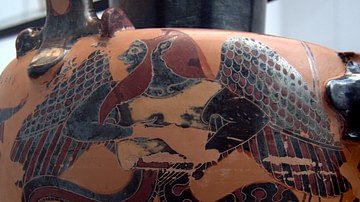
Typhon
Typhon (also Typheus) is the largest and most dreadful monster in Greek mythology. He was tall, with a brutish face, and had wings, countless snakeheads in place of hands, and a lower body made up of coiled serpents. His eyes flashed...

Definition
Cyclops (Play)
The satyr-play The Cyclops was written by Euripides, one of the great Greek tragedians, in 412 or 408 BCE. Like many of his fellow tragedians, Euripides centers his play on a well-known story from Greek mythology. The Cyclops is...

Definition
Noah's Ark
Noah’s Ark is the boat that saved a generation of humans and animals when the God of Israel decided to destroy the human race by sending a great flood upon the earth. The story shares many elements with ancient, neighboring civilizations...

Definition
Hinduism
Hinduism is the oldest religion in the world, originating in Central Asia and the Indus Valley, still practiced in the present day. The term Hinduism is what is known as an exonym (a name given by others to a people, place, or concept...

Definition
Ninurta - The Sumerian Hero-God of War
Ninurta (identified with Ningirsu, Pabilsag, and the biblical Nimrod) is the Sumerian and Akkadian hero-god of war, hunting, and the south wind. He first appears in texts in the early 3rd millennium BCE as an...

Definition
Script - The Written Record of Humanity
Script is the written expression of a language. Cuneiform, the first script, was invented in Sumer, Mesopotamia, circa 3600/3500 BCE; hieroglyphics sometime prior to the Early Dynastic Period in Egypt (circa...
