
Search
Remove Ads
Advertisement
Search Results

Definition
Tokugawa Tsunayoshi
Tokugawa Tsunayoshi (1646-1709) governed Japan as the fifth shogun of the Edo period (1603-1876). He has often been ridiculed as the 'dog shogun' because of the laws he enacted to protect the lives of animals. Economically...
Definition
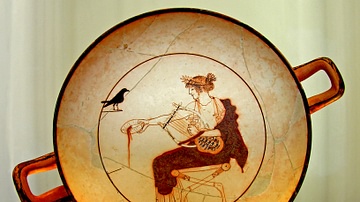
Lyre
The lyre was a stringed musical instrument played by the ancient Greeks. It was probably the most important and well-known instrument in the Greek world. The lyre was closely related to the other stringed instruments: the chelys which...

Video
Who are the Nine Muses of Greek Mythology?
The nine muses of Greek mythology are the goddesses of song, dance, music, and poetry and were among the most important deities of the ancient Greek pantheon as the source of inspiration for poets. The most...

Image
Erato
A 1st century CE Roman sculpture of Erato, the Muse of lyric poetry, playing the lyre. (Vatican Museums, Rome).

Article
The Temple of the Emerald Buddha
A small carved figurine sits high on a grand multi-tiered pedestal in a magnificent wat (temple) in Bangkok, Thailand. It has been sitting there since 1784 CE and was originally thought to be made of emerald. Hundreds...

Article
Chariots in Ancient Indian Warfare
The chariot was the elite arm of ancient Indian armies in the Vedic (1500 BCE – 1000 BCE) and Epic periods (described by the Ramayana and the Mahabharata, 1000-600 BCE) because of the advantages it conferred and...

Article
Gilgamesh, Enkidu, and the Netherworld - Messages From the Afterlife
Gilgamesh, Enkidu, and the Netherworld is a Sumerian poem pre-dating The Epic of Gilgamesh and featuring its central characters. It is sometimes included in modern-day translations as Book...

Article
The Iraq Museum: A Brightness in the Darkness
For whom have I labored? For whom have I journeyed? For whom have I suffered? I have gained absolutely nothing for myself, I have only profited the snake, the ground lion! The Epic of Gilgamesh, Tablet...

Article
Education for Girls in Ancient Rome
The upbringing and education of girls in ancient Rome are rarely addressed in ancient sources. A young Roman girl from an affluent family married very young, often in her mid-teens, and girls, according to tradition...

Interview
Interview: The Werewolf in the Ancient World by Daniel Ogden
In this interview, World History Encyclopedia is talking to author Daniel Ogden about his new book The Werewolf in the Ancient World. Daniel Ogden (Author): Thank you for inviting me! Kelly...
