
Search
Remove Ads
Advertisement
Search Results

Definition
Cult of the Supreme Being
The Cult of the Supreme Being was a deistic cult established by Maximilien Robespierre (1758-1794) during the French Revolution (1789-1799). Its purpose was to replace Roman Catholicism as the state religion of France...

Definition
Catherine the Great
Catherine II of Russia (Catherine the Great) was empress regent of Russia from 1762-1796. She was born in Prussia to Prince Christian August of Anhalt-Zerbst (1690-1747) and Princess Johanna Elisabeth of Holstein-Gottorp (1712-1760...

Definition
State of Nature
The state of nature is an idea which became especially popular with certain philosophers during the Enlightenment, notably Thomas Hobbes (1588-1679), John Locke (1632-1704), and Jean-Jacques Rousseau (1712-1778). It refers to...

Definition
Mithra
Mithra is the Persian god of the rising sun, contracts, covenants, and friendship. He also oversaw the orderly change of the seasons, maintained cosmic order, and was responsible for bestowing divine grace on kings, legitimizing their...

Definition
Paul the Apostle
Paul was a follower of Jesus Christ who famously converted to Christianity on the road to Damascus after persecuting the very followers of the community that he joined. However, as we will see, Paul is better described as one...

Definition
Greek Alphabet
The Greek Alphabet developed from the Phoenician script at some point around the 8th century BCE. The earlier Mycenaean Linear B script, used primarily for lists and inventories, had been lost during the Greek Dark Age, and the...

Definition
Izumi Shikibu
Izumi Shikibu was a writer, poet, and member of the Japanese court during the Heian Period (794-1185 CE). Her birth date is variously given as sometime in the 970's CE, and she died in the 1030's CE. In her celebrated memoirs, known...
Definition
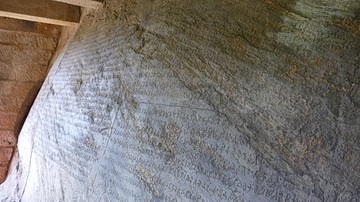
The Edicts of Ashoka the Great
The Edicts of Ashoka are 33 inscriptions engraved on pillars, large stones, and cave walls by Ashoka the Great (r. 268-232 BCE), the third king of the Mauryan Empire (322-185 BCE) of India. One set, the so-called Major...

Definition
Gnosticism
Gnosticism is the belief that human beings contain a piece of God (the highest good or a divine spark) within themselves, which has fallen from the immaterial world into the bodies of humans. All physical matter is subject to decay...

Definition
Antoine Barnave
Antoine Pierre Joseph Marie Barnave (1761-1793) was a French lawyer, politician, and one of the most influential orators of the early stage of the French Revolution (1789-1799). He is notable for being a champion of constitutional...
