
Search
Remove Ads
Advertisement
Search Results
Definition
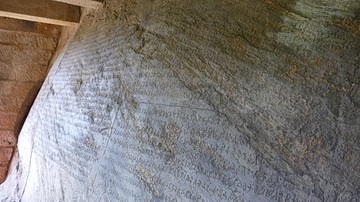
The Edicts of Ashoka the Great
The Edicts of Ashoka are 33 inscriptions engraved on pillars, large stones, and cave walls by Ashoka the Great (r. 268-232 BCE), the third king of the Mauryan Empire (322-185 BCE) of India. One set, the so-called Major...

Definition
Gnosticism
Gnosticism is the belief that human beings contain a piece of God (the highest good or a divine spark) within themselves, which has fallen from the immaterial world into the bodies of humans. All physical matter is subject to decay...

Definition
Antoine Barnave
Antoine Pierre Joseph Marie Barnave (1761-1793) was a French lawyer, politician, and one of the most influential orators of the early stage of the French Revolution (1789-1799). He is notable for being a champion of constitutional...

Definition
Józef Poniatowski
Prince Józef Poniatowski (1763-1813) was a Polish soldier and patriot, who served as commander-in-chief of the Polish army during the Napoleonic Wars (1803-1815). A steadfast ally of French Emperor Napoleon I (r. 1804-1814; 1815...

Definition
Emancipation Proclamation - Lincoln's Call for Freedom
The Emancipation Proclamation was an executive order issued by US President Abraham Lincoln on 1 January 1863, at the height of the American Civil War (1861-1865). It proclaimed that "all persons...

Collection
12 Events That Changed History - How the World as We Know it Came to Be
Many events can be said to have changed history, and not everyone might agree with all of those chosen for this collection, but – undeniably – these twelve would appear somewhere on...

Article
Twelve Gods of Persian Mythology
Ancient Persian Mythology is the term now referencing ancient Iranian religion prior to the rise of Zoroastrianism between c. 1500-1000 BCE. This was a polytheistic faith with a pantheon led by the supreme god Ahura...

Article
Ancient Persian Gods, Heroes, and Creatures - The Complete List
The term 'mythology' comes from the Greek mythos (story-of-the-people) and logos (word or speech), meaning the spoken story of a people. Every civilization of the ancient world developed a...

Article
50 Biblical Phrases, Idioms, & Metaphors
In the Western tradition, many phrases and terms from the Bible are utilized as allegory, metaphors, idioms, or simply to describe the characteristics of a known person or event. They have become an essential...

Article
Cultural Links between India & the Greco-Roman World
Cyrus the Great (558-530 BCE) built the first universal empire, stretching from Greece to the Indus River. This was the famous Achaemenid Empire of Persia. An inscription at Naqsh-i-Rustam, the tomb...
