
Search
Remove Ads
Advertisement
Search Results

Article
Mesopotamian Inventions - Creating the Future
Mesopotamian inventions include many items taken for granted today, most of which were created during the Early Dynastic period (circa 2900-2350/2334 BCE) or developed from achievements of the Uruk period...

Definition
Ancient Persian Governors
The Achaemenid Persian Empire functioned as well as it did because of the efficient bureaucracy established by its founder Cyrus the Great (r. c. 550-530 BCE) which was administered through the satrapy system. A Persian...

Definition
Mesopotamia - The Beginning of Beginnings
Mesopotamia (from the Greek, meaning "between two rivers") was an ancient region located in the Near East (Middle East) bounded in the northeast by the Zagros Mountains and in the southeast by the Arabian Plateau...

Definition
Ancient Persian Art and Architecture
Persian art and architecture in the present day is associated with the nation of Iran and usually designated as beginning with the Achaemenid Empire (c. 550-330 BCE) but has an even longer history with its origins...

Definition
Ionia
Ionia was a territory in western Anatolia (modern-day Turkey) populated by the Ionians (Greeks who spoke the Ionian dialect) in c. 1150 BCE. It is best known as the birthplace of Greek philosophy (at Miletus) and the site of the Ionian...

Definition
Sardis
Sardis (near modern-day Sart, Turkey) was the capital of the ancient Kingdom of Lydia founded (according to Herodotus) by the Heracleidae, the Heraclid Dynasty descended from the hero Heracles (Hercules). The city was famous in antiquity...

Image
Cylinder Seal from Kish
This is a cylinder seal with an image of its impression. It was found at Kish city, Mesopotamia, Iraq. 3200-2900 BCE. (The Sulaimaniya Museum, Iraq).
Image
Cylinder Seal with a King Pouring an Offering to Shamash
This lapis lazuli cylinder seal shows a libation scene. A robed king stands before the ascending Sun God Shamash and pours an offering. The suppliant goddess (with necklace counterweight) stands...
Image
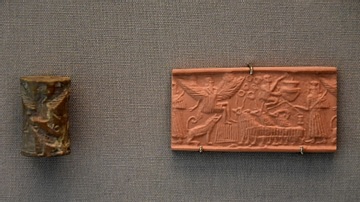
Myth of Etana Cylinder Seal
This calcite cylinder seal depicts the myth of Etana, the shepherd and the legendary king of Uruk, who was carried up to heaven by an eagle to obtain an heir. Etana's ascent is watched by the shepherd and his dog, with...
Image
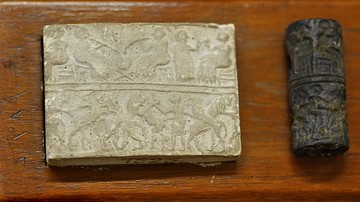
Cylinder Seal From Mattarah, Iraq
This cylinder seal dates back to the early dynastic period, 2900-2350 BCE, and was found at Mattarah village (near Kirkuk), Mesopotamia, modern-day Iraq. The seal's impression has two registers. The lower one features...
