
Search
Remove Ads
Advertisement
Search Results

Image
Cylinder Seal of Queen Puabi
This seal was found by Puabi's right arm inside her grave. The seal depicts a banquet/feast scene, in two horizontal registers; one of the typical themes of the Early Dynastic III seals. The upper register depicts a...

Image
Cylinder of Ashurbanipal II
Clay cylinder of the Assyrian king Ashurbanipal II (reigned 668-626 BCE). The cuneiform inscriptions on this cylinder talk about Nemitti-Ellil (or Nemet-Enlil) and the inner wall of Babylon's double city walls. From Iraq...

Video
Ancient Persia and the Achaemenid Persian Empire
The region of ancient Persia, which is modern-day Iran, has one of the longest histories, reaching back to the Palaeolithic Age, some one hundred thousand years ago. Between circa 1500 and 1000 BCE, a...

Definition
Babylon - The Gate of the Gods
Babylon is the most famous city from ancient Mesopotamia, whose ruins lie in modern-day Hillah, Iraq, 59 miles (94 km) southwest of Baghdad. The name is derived from bav-il or bav-ilim, which in Akkadian meant "Gate...

Image
Cylinder Seal with Ninurta
Grey or brown chalcedony cylinder seal in the modelled style; a bearded god (Ninurta), wearing a square, star-topped, horned head-dress and a vertically striated, tiered, fringed open robe over a fringed kilt, with a star-tipped...
Image
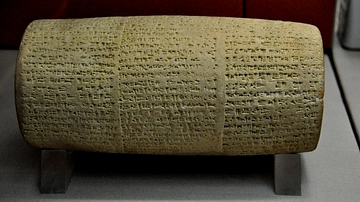
Terracotta Cylinder of King Nabonidus
This cylinder includes three columns of cuneiform inscriptions that record the reconstruction and restoration of the temple of Shamash, the sun God, at Larsa, by the last king of Babylon, Nabonidus. Probably from...
Image
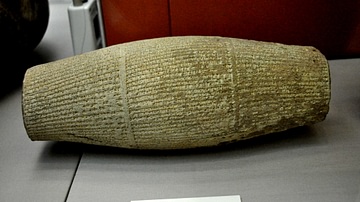
Terracotta Clay Cylinder of King Nebuchadnezzar II
The three columns of cuneiform inscriptions on this cylinder mention the building and reconstruction of various shrines, quays, gates, and processional boats by king Nebuchadnezzar II at Babylon for...

Image
Cylinder of Warad-Sin of Larsa
An inscribed clay cylinder of Warad-Sin, ruler of Larsa. From Babylon (modern Babel Governorate, Iraq). 1834-1823 BCE. (The Pergamon Museum, Berlin).
Image
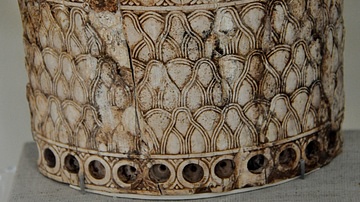
Fragment of an Ivory Cylinder from Fort Shalmaneser
This is a fragment of an ivory cylinder. The original decorative insets are lost. Neo-Assyrian Period, 8th century BCE. From Fort Shalmaneser at Nimrud, Mesopotamia, modern-day Iraq. A loan from the...
Image
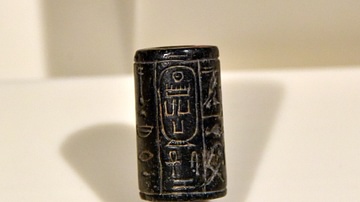
Cylinder Seal of Menkaure
On this basalt cylinder seal, the name of the Egyptian pharaoh Menkaure (2532 - c. 2500 BCE) appears within a cartouche. From Egypt, precise provenance is unknown. Old Kingdom, 4th Dynasty, reign of Menkaure, 2539-2511...
