
Search
Remove Ads
Advertisement
Search Results

Video
82nd & Fifth: Cylinder Seals
http://82nd-and-fifth.metmuseum.org/sealed Explore this object: http://82nd-and-fifth.metmuseum.org/cylinder-seal-and-modern-impression-nude-bearded-hero-wrestling-with-a-water-buffalo-bull-man-wrestling-with-lion-mesopotamia-41.160.281...

Image
Neo-Assyrian Cylinder Seal Possibly Depicting Tiamat as a Serpent
The seal may illustrate a scene from the epic of creation in which the forces of chaos, led by Tiamat, are defeated by a god representing cosmic order, probably Ninurta. 900 BCE - 750...
Image
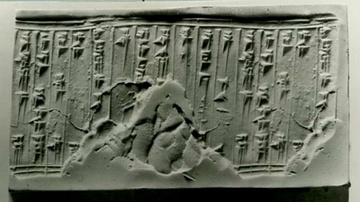
Assyrian Cylinder Seal Inscribed in Cuneiform Script
Though not necessarily an Israelite object, this object was uncovered around Samaria and dates to the Iron Age II (8th century BCE). It is 3.9 cm long (The Israel Museum, Jerusalem). The image is significant...
Image
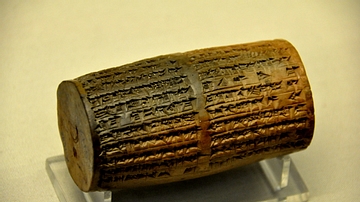
King Nabonidus Clay Cylinder from Ur
This clay document tells us how Nabonidus (the last king of Babylon) built and reconstructed the temple of Sin, the moon God, at Ur. It also mentions a prayer for the king and Beslshazzar, his son. From Ur, neo-Babylonian...
Image
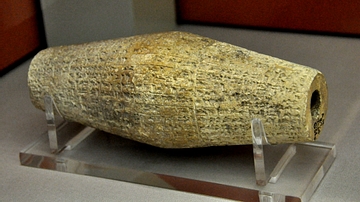
Nebuchadnezzar II's Terracotta Cylinder of Shamash Temple
The temple of the sun God, Shamash, at Sippar reached a state of complete disrepair. The gods conveyed a message to the king via omens that he was given approval to rebuild and repair the temple...
Image
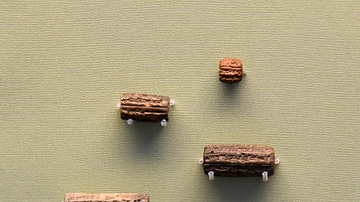
Terracotta Cylinder Amulets
These amulets were inscribed with a spell recruiting the mighty god Ninurta for protection. They were worn around the neck and their size corresponds to the needs of different age groups. From Nimrud and Nineveh, Mesopotamia...

Image
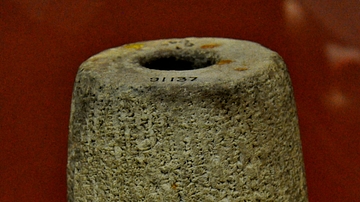
Terracotta Cylinder of the Babylonian King Nabopolassar
This document records the king’s reconstructive work on the wall of the city of Babylon. From Babylon (modern Babel governorate), neo-Babylonian era, 625-605 BCE, Mesopotamia, Iraq. (The British...
Image
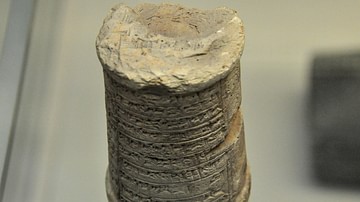
Terracotta Cylinder of Nebuchadnezzar II
This document records the king’s reconstructive work at the cities of Sippar, Ururk, Ur, Borsippa, Larsa, and Dilbat. It also commemorates the king’s repairing of the temple of Ninkarrak (a form of the healing...
Image
Fired clay Cylinder Mentioning Amar-Sin
Scholarly copy of writings on a brick of Amar-Sin (Amar-Suen), a neo-Sumerian king who reigned between 2040-2036 BCE. The copy was written in the time of Sin-balassu-iqbi, governor of Ur during the reign of...

Article
Herodotus on Lydia
Herodotus’ narrative on Lydia takes up almost one half of Book I of his Histories and the section dealing with King Croesus is among the best-known and often anthologized. The last section, in which he discusses Lydian women...
