
Search
Remove Ads
Advertisement
Search Results
Image
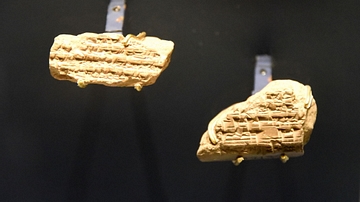
Additional Fragments of the Cyrus Cylinder Text
These 2 small fragments once belonged to a large clay tablet inscribed with a duplicate of the Cyrus Cylinder text. They were identified among The British Museum extensive collections of clay tablets in...
Image
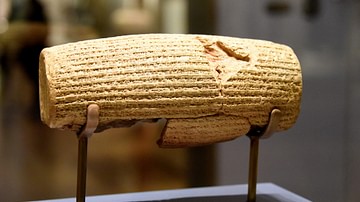
The Cyrus Cylinder
This clay tablet dates back to the reign of the Achaemenid king Cyrus the Great, who ruled Iran between 550-530 BCE. The cylinder describes the king's peaceful capture of the city of Babylon in the year 539 BCE and he how built...

Video
A new beginning for the Middle East: The Cyrus Cylinder and Ancient Persia
The Cyrus Cylinder is one of the most famous objects to have survived from the ancient world. It was inscribed in Babylonian cuneiform on the orders of Persian King Cyrus the Great...

Video
The Cyrus Cylinder from Ancient Babylon and the Beginning of the Persian Empire
Lecture by Dr. John E. Curtis, OBE, FBA, Keeper of Special Middle East Projects, The British Museum. Introduction by Joan Aruz, Curator in Charge, Department of Ancient Near Eastern...

Definition
Ancient Persia
Persia (roughly modern-day Iran) is among the oldest inhabited regions in the world. Archaeological sites in the country have established human habitation dating back 100,000 years to the Paleolithic Age with semi-permanent settlements...

Article
Herodotus in Art
Herodotus' Histories with their historical, geographical, ethnographic, and religious aspects, have always been a source of delight and interest, not only for generations of readers, students, and storytellers, but also for artists...

Definition
Ancient Persian Government
The government of ancient Persia was based on an efficient bureaucracy which combined the centralization of power with the decentralization of administration. The Achaemenid Empire (c. 550-330 BCE) founded by Cyrus the...

Definition
Cambyses II
Cambyses II (r. 530-522 BCE) was the second king of the Achaemenid Empire. The Greek historian Herodotus portrays Cambyses as a mad king who committed many acts of sacrilege during his stay in Egypt, including the slaying of the sacred...

Article
Achaemenid Kings List & Commentary
The Achaemenid Empire (c. 550-330 BCE) was the first great Persian political entity in Western and Central Asia which stretched, at its peak, from Asia Minor to the Indus Valley and Mesopotamia through Egypt. It...

Definition
Croesus
Croesus (r. 560-546 BCE) was the King of Lydia, a region in western Asia Minor (modern-day Turkey) and was so wealthy that the expression "as rich as Croesus" originates in reference to him. Best known for his wealth, he is also famous...
