
Search
Remove Ads
Advertisement
Search Results
Article
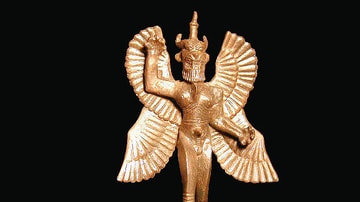
Twelve Menacing & Protective Mythological Figures
The term mythology comes from the Greek words mythos (“story of the people”) and logos (“word”) and so is defined as the spoken (later written) story of a culture. Modern scholars have divided myths...

Definition
Three Kingdoms Period in Korea
The Three Kingdoms Period of ancient Korea (57 BCE – 668 CE) is so-called because it was dominated by the three kingdoms of Baekje (Paekche), Goguryeo (Koguryo), and Silla. There was also, though, a fourth entity...

Definition
Ming Porcelain
The porcelain of the Ming Dynasty of China (1368-1644 CE) benefitted, as did other arts, from the economic success of the 15th century CE, in particular, and the consequent surge in demand for quality handcraft production both...

Definition
Silk Road
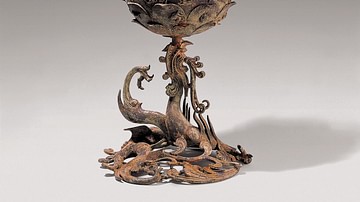
The Silk Road was a network of ancient trade routes, formally established during the Han Dynasty of China in 130 BCE, which linked the regions of the ancient world in commerce between 130 BCE-1453 CE. The Silk Road was not a single...
Definition
Baekje
Baekje (Paekche) was one of the Three Kingdoms which ruled over ancient Korea from the 1st century BCE to the 7th century CE. Controlling territory in the south-western part of the peninsula the kingdom was in constant rivalry with the...

Definition
Korean War - How the Cold War Became a Hot War
The Korean War was a Cold War conflict that took place between North and South Korea from 1950 to 1953. It pitted US-led United Nations (UN) forces against the communist bloc supported by the Soviet Union...

Article
Trade Goods of the East India Company
The English East India Company (EIC) was founded in 1600, and it came to control both trade and territories in India, as well as a trade monopoly with China. Goods the EIC traded included spices, cotton cloth...

Definition
Ancient Pyongyang
Pyongyang (aka Pyeongyang) was the capital of several successive ancient Korean kingdoms. Located on the Daedong River in the north of the peninsula, the site was chosen by the legendary Dangun (Tangun), founder of the first...

Definition
Great Wall of China
The Great Wall of China is a barrier fortification in northern China running west-to-east 13,171 miles (21,196 km) from the Jiayuguan Pass (in the west) to the Hushan Mountains in Liaoning Province in the east, ending at the...

Definition
Lao-Tzu
Lao-Tzu (l. c. 500 BCE, also known as Laozi or Lao-Tze) was a Chinese philosopher credited with founding the philosophical system of Taoism. He is best known as the author of the Laozi (later retitled the Tao-Te-Ching translated as “The...
