
Search
Remove Ads
Advertisement
Search Results

Definition
Emperor Taizong of Tang
Taizong (birth name, Li-Shimin, l. 598-649 CE, r. 626-649 CE) was the second emperor of the Tang Dynasty and is considered one of the greatest rulers in Chinese history for his reforms of the government and the laws, his...

Image
Chinese Terracotta Warrior
A portion of the Terracotta Army, the clay life-size army in the tomb of the Qin emperor Shi Huangdi. c. 210 BCE, Shaanxi Province, China.

Image
Neolithic Chinese Jar
This jar dates from the 26th century BCE and is made of earthenware with pigments. It was made by the Majiayao Yangshao culture during the Banshan phase (c. 2655-2330 BCE). (Iris & B. Gerald Cantor Center for Visual Arts at...

Video
Interview with Garry Shaw - Egyptian Mythology Travel Guide
Join World History Encyclopedia as they talk to Garry Shaw, an Egyptologist and author of a brand new book Egyptian Mythology: A Travelers Guide From Aswan to Alexandria. Garry's book on Egyptian...

Article
Twelve Menacing & Protective Mythological Figures
The term mythology comes from the Greek words mythos (“story of the people”) and logos (“word”) and so is defined as the spoken (later written) story of a culture. Modern scholars have divided myths...
Image
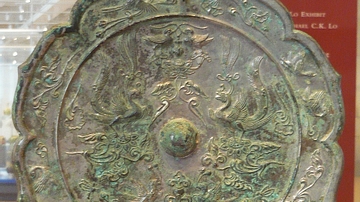
Chinese Bronze Mirror with Phoenix Motif
This Chinese bronze mirror with a phoenix motif dates from the Tang dynasty (618-907 CE). The phoenix was the female counterpart to the male dragon in mythology, and it was also a symbol of Chinese empresses...

Definition
Ancient Korea
Korea, located on a large peninsula on the eastern coast of the Asian mainland, has been inhabited since Neolithic times. The first recognisable political state was Gojoseon in the second half of the first millennium BCE. From the...

Image
Chinese Diamond Sutra
The Buddhist text known as the Diamond Sutra is believed to be the oldest surviving printed book in the world, dated to 868 CE and written in Chinese. This work is one of the most important works of the Buddhist tradition.

Video
Ancient Chinese Inventions
This video describes the many inventions of ancient China extending to the Early Middle Ages, and how these innovations impacted other aspects of Chinese history.

Image
Chinese Eunuchs
A mural depicting a group of eunuchs, the slaves and influential advisors of many Chinese emperors. Mural from the tomb of the prince Zhanghuai, 706 CE, Qianling, Shaanxi, China.
