
Search
Remove Ads
Advertisement
Search Results

Image
Chinese Jar with Green Glaze
This jar comes from China and dates from the Sui dynasty (581-618 CE). It is made of stoneware with green glaze. (Iris & B. Gerald Cantor Center for Visual Arts at Stanford University, Stanford, California)

Image
Chinese Kowtowing Figure
742 CE. Earthenware with pigment. Excavated from Crown Prince Li Xian's tomb at Pucheng County, 2000.
Shaanxi Provincial Institute of Archaeology. (Photo taken at the Art Gallery of NSW, Sydney Australia)

Definition
Sui Dynasty
The Sui Dynasty (581-618 CE) was a brief one with only two reigning emperors but it managed to unify China following the split of the Northern and Southern Dynasties period. As had happened previously in Chinese history, a short-lived...

Definition
Gojoseon
Gojoseon (Gochoson or Old Choson) was an ancient kingdom which ruled northern Korea in the second half of the first millennium BCE. Gojoseon possessed the most advanced culture in the Korean peninsula at that time and was an important...

Interview
Interview: Buddhism in Korea
In this interview, James Blake Wiener, Co-Founder and Communications Director at Ancient History Encyclopedia (AHE), speaks to Emeritus Professor James H. Grayson, Professor of Korean Studies at the University of Sheffield...

Image
Ancient Chinese Tiger Bone
At roughly 22 cm (9 in) in length and containing 22 Chinese characters, this tiger bone was made in the third year of Emperor Dixin (fl. c. 1152 BCE) of the Shang Dynasty (c.1600-1046 BCE). (Royal Ontario Museum, Toronto...
Image
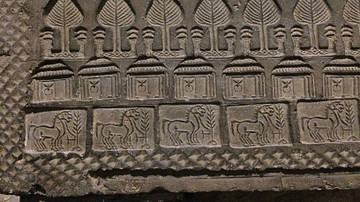
Ancient Chinese Brick from Tomb Doorway
This is an ancient Chinese brick from a tomb doorway, which was created during the Han Dynasty (206 BCE-220 CE) and made from clay. This brick shows trees, tomb doorways, and tethered horses. (Victoria & Albert...
Image
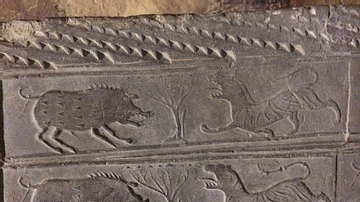
Ancient Chinese Brick
This is an ancient Chinese brick from a tomb doorway, which was created during the Han Dynasty (206 BCE-220 CE) and made from clay. This brick depicts dueling boars and tigers. (Victoria & Albert Museum, London)

Article
Ming Taxation & the Silver Economy
The rulers of China's Ming dynasty (1368-1644) acquired an insatiable desire for silver in the 16th century, largely to pay for huge prestige projects like building the Forbidden City in Beijing and repairing the...

Article
Most Popular Gods & Goddesses of Ancient China
There were over 200 gods and goddesses worshipped throughout ancient China, but if one were to count every deity or spirit, the number would be over 1,000. Each town, village, city, field, farm, and sometimes...
