
Search
Remove Ads
Advertisement
Search Results

Image
Map of the The Hallstatt Culture
A map illustrating the spread of the Hallstatt culture, a predominant European Late Bronze and Early Iron Age culture from the 12th to 5th centuries BCE. It is generally accepted as a proto-Celtic culture. It is named...

Image
Map of the Urnfield Culture c. 1300 BCE
This map illustrates the spread of the Urnfield culture in Europe by around 1300 BCE, a late Bronze Age archaeological horizon named for the practice of cremating the dead and placing their ashes in urns buried...

Image
Majiayao Culture Linear Design Pottery
Pottery vessel with linear whirl design from China, Gansu or Qinghai Province, Majiayao culture, late 4th / early 3rd millennium BCE.
Exhibited at the Rietberg Museum, Zurich, Switzerland.
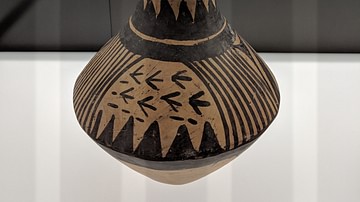
Image
Jar With Stylized Landscape, Majiayao Culture
A pottery jar with stylized landscape from Gansu or Qinhai Province, China. Produced by the Majiayao Culture, late 4th / early 3rd millennium BCE.
Exhibited at Museum Rietberg, Zurich, Switzerland.

Definition
Jurchen Jin Dynasty
The Jurchen Jin dynasty (meaning “Golden”) ruled parts of China, Mongolia, and northern Korea from 1115 to 1234 CE. The Jurchen originated from Manchuria, but in conquering the neighbouring Liao empire of the Khitan and parts...

Definition
Ancient Celts
The ancient Celts were various tribal groups living in parts of western and central Europe in the Late Bronze Age and through the Iron Age (c. 700 BCE to c. 400 CE). Given the name Celts by ancient writers, these tribes and their...

Definition
Jade Emperor
The Supreme August Jade Emperor is the supreme deity of Chinese tradition and is otherwise known as Yuhuang Shangdi (Yu-huang Shang-ti), Yudi (Yu Ti) or Mr. Heaven (Lao-t'ien ye). He governs the cosmos and resides in a magnificent...

Image
Traditional Chinese Roof Tiles & Acroteria
A detail of a roof from the Forbidden Cty, Beijing. In ancient Chinese architecture the yellow tiles, curved roof, and dragon acroteria were all typical features of imperial buildings.
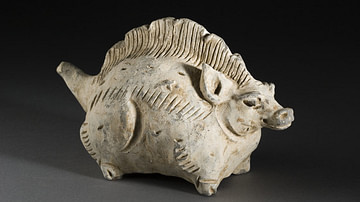
Image
Chinese Pig-Dragon Sculpture
A Chinese pig-dragon sculpture. China, probably Yunnan Province, Yuan dynasty, 1279-1368.
Los Angeles County Museum of Art.

Article
The Art of the Tang Dynasty
The art of the Tang Dynasty (618-907 CE) began to explore new possibilities in materials and styles with landscape painting and ceramics, in particular, coming to the fore. New techniques, a wider range of colours and...
