
Search
Remove Ads
Advertisement
Search Results
Image
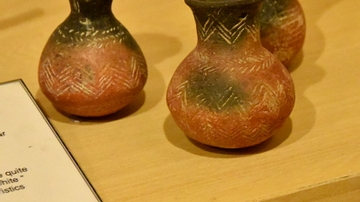
Philia Culture Pottery from Cyprus
These pottery vessels show prominent Anatolian characteristics. Early Bronze Age in Cyprus, 2300-1900 BCE. (Museum of Archaeology, Istanbul, Turkey).
Image
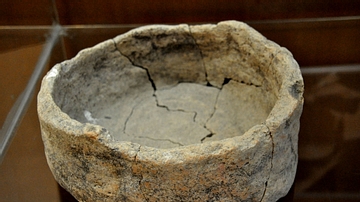
A Dish from the Jarmo Culture
This rounded coarse-ware dish was found in Tell Tapa Raza, Sharazor Plain, Modern Sulaimaniya Governorate, Iraq. It dates back to the Jarmo period, 7000 BCE. (The Sulaimaniya Museum, Iraq).

Image
Gandao in Kalasha culture
Gandao is the wooden image aimed at immortalizing the important departed souls of the Kalasha family member. Gandao is installed at cemetery. The Kalasha is sole pagan tribe of Pakistan with numerical strength of 4000...
Image
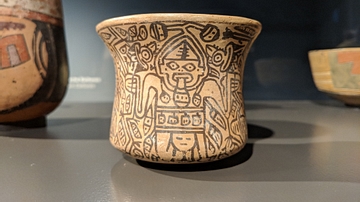
Nazca Culture Vessel
Vessel from the Nazca Civilization. Peru, 2nd to 6th century CE. Fired clay.
Exhibited at Museum Rietberg, Zurich, Switzerland.
Image
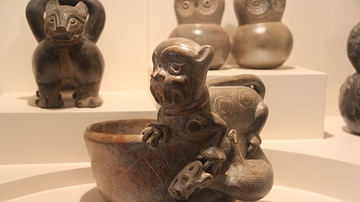
Cupisnique Culture Sacred Animals
This piece shows a feline, owl, serpents, and condor. The owl and condor represented the sky while the feline represented the earth and dominance. The serpent represented the subterranean world. Housed in the Museo...

Image
Chinese Bronze Mirror with Phoenix Motif
This Chinese bronze mirror with a phoenix motif dates from the Tang dynasty (618-907 CE). The phoenix was the female counterpart to the male dragon in mythology, and it was also a symbol of Chinese empresses...

Definition
Sui Dynasty
The Sui Dynasty (581-618 CE) was a brief one with only two reigning emperors but it managed to unify China following the split of the Northern and Southern Dynasties period. As had happened previously in Chinese history, a short-lived...

Definition
Silk in Antiquity
Silk is a fabric first produced in Neolithic China from the filaments of the cocoon of the silk worm. It became a staple source of income for small farmers and, as weaving techniques improved, the reputation of Chinese silk spread...

Definition
Goguryeo
Goguryeo (Koguryo) was a kingdom which ruled northern Korea during the Three Kingdoms period from the 1st century BCE to 7th century CE. The kingdom flourished in the 5th and 6th century CE and has left a rich cultural heritage best...

Definition
Ancient Korean Coinage
The coinage of ancient Korea (pre-13th century CE) first employed Chinese coins, known locally as the oshuchon. Korean rulers began minting their own metal coins from the late 10th century CE, first in copper and iron, and...
