
Search
Remove Ads
Advertisement
Search Results

Image
Canopic Jars of Neskhons
Calcite canopic jars of Neskhons (21st Dynasty) with painted wooden lids representing the Four Sons of Horus.

Image
Etruscan Canopic Figure Urn
Etruscan terracotta canopic urn with a female head and articulated arms, from Chiusi (Italy), around 550-500 BCE. (Louvre Lens, France)
Image
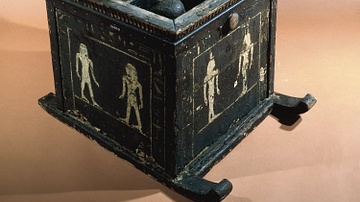
Canopic Chest
Canopic chest of Neby (dating from 18th Dynasty, found in Thebes, Egypt). The painted sides bear hieroglyphic text and representations of Neith, Serket, Isis, Nephthys, and Sons of Horus.

Definition
Serket
Serket (also known as Serqet, Selkis, and Selket) is an Egyptian goddess of protection associated with the scorpion. She was worshipped widely in Lower Egypt as a great Mother Goddess in the Predynastic Period (c. 6000- c. 3150 BCE) and...
Image
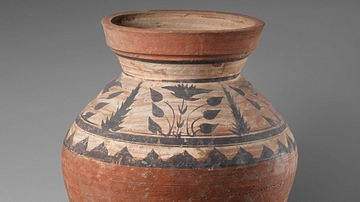
Ptolemaic Storage Jar
This pottery jar was a storage vessel for funerary offerings and is thought to have once held some type of beef broth. On its surface, a beautiful floral pattern is painted. The jar was found in a Ptolemaic era tomb near Thebes...
Image
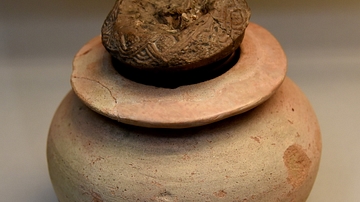
Sealed Clay Jar Stopper
Two officials certified the contents of the jar that was sealed with this stopper. Impressions of fingers and a thumb are visible on the top. The stopper is displayed here on a similar jar dating from about the same period...
Image
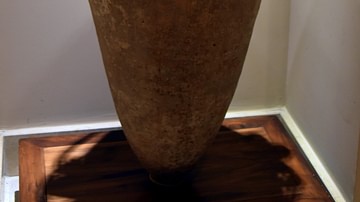
Transportation or Storage Jar from Madaba
Large jar built up with coils of clay and then trimmed upside down on the wheel. Its base is tapered making the form similar to a plumb-bob when hanged by the handles. This type of jar was commonly associated...

Article
A Visual Glossary of Greek Pottery
Alabastron (pl. alabastra) - a small jar for storing perfumes, named after the material (alabaster) the first examples were made from. They were often carried by a string looped around the neck of the vessel. Amphora...

Image
A Jar from the Jemdet Nasr Period
This painted jar dates back to the Jemdet Nasr period, 3100-2900 BCE. The jar displays geometric grey and red motifs. (The Sulaimaniya Museum, Iraq).
Image
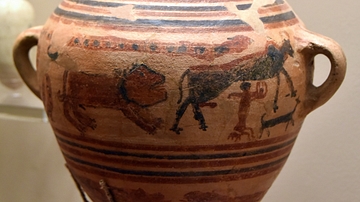
Pottery Jar Showing a Myth from Tell Zar'a
Lare jar painted in red and black on beige. The paintings show animal scenes in two registers. In the lower register, two large snakes lie opposite each other. In the upper one, framed by horizontal lines...
