
Search
Remove Ads
Advertisement
Search Results
Image
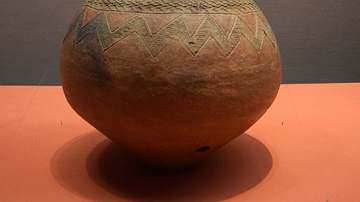
Yayoi Period Jar
A jar of the Yayoi Period, 1st-3rd century CE. From Kugahara, Ota-ku, Tokyo. Important Cultural Property. (Tokyo National Museum)
Image
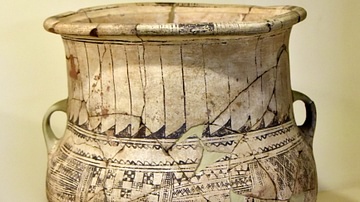
Jar from Bogazkoy
Double handed terracotta jar, from the city of Boğazköy, central Anatolia, in modern-day Turkey. 8th century BCE. (Museum of Archaeology, Istanbul, Turkey).
Image
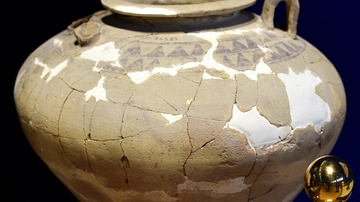
Jar from Shuruppak
Large pear-shaped and single-handed jar. The rim is decorated with geometric motifs. From Tell Fara (ancient Sharuppak), southern Mesopotamia, Iraq. 5000-4000 BCE. On display at the Iraq Museum in Baghdad.
Image
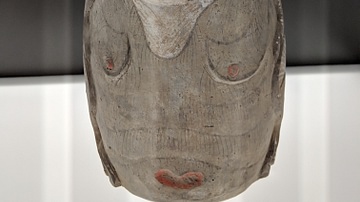
Bear-Shaped Jar from the Han Dynasty
A jar in the shape of a bear, Shaanxi / Henan Region, China. Western Han Dynasty, 2nd/1st century BCE. Exhibited in Museum Rietberg, Zurich, Switzerland.

Image
Neolithic Chinese Jar
This jar dates from the 26th century BCE and is made of earthenware with pigments. It was made by the Majiayao Yangshao culture during the Banshan phase (c. 2655-2330 BCE). (Iris & B. Gerald Cantor Center for Visual Arts at...
Image
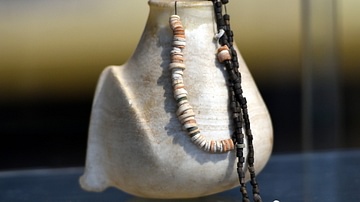
Small Jar from Tell es-Sawwan
Small marble jar which was found at Tell es-Sawwan, Iraq. Tell es-Sawwan is an ancient archaeological site in Saladin Province (about 110 Km north of Baghdad) and is associated with the Samarra culture. 6000-5800 BCE...
Image
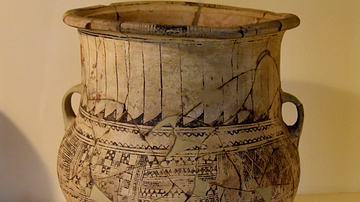
Double-Handed Jar
Painted double-handed terracotta jar. 8th century BCE. From Bogazkoy (Boğazkale) or Carchemish, in modern-day Turkey. (Museum of Archaeology, Istanbul, Turkey).
Image
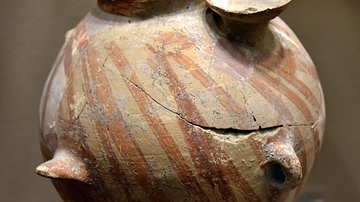
Painted Pottery Jar from Arqub az-Zahr
Jar decorated in red, like a burnished slip or groups of lines The spouts applied to some jars may have served as stands for dipper juglets. Early Bronze Age, 3600-3100 BCE. From Arqub az-Zahr, Jordan. (The Jordan...

Image
Pottery Jar with Ankh Sign
A pottery jar with three painted representations of the ankh sign with 2 arms holding 2 was scepters. From the New Kingdom of Egypt, Ramesside Period, 1292-1069 BCE.
The British Museum, London.
Image
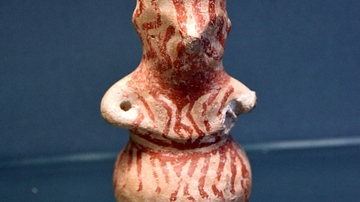
Female-Shaped Painted Jar
This painted jar was shaped like a woman. Female figurines were important in Anatolia. Often, the breasts and thighs were emphasized, suggesting that they represent fertility goddesses. Possibly from Hacilar, South-Western...
