
Search
Remove Ads
Advertisement
Search Results
Image
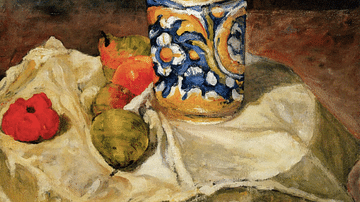
Still Life with Italian Earthenware Jar by Cézanne
A c. 1873 still life painting in oils, Still Life with Italian Earthenware Jar, by Paul Cézanne (1839-1906), the French post-impressionist artist. This painting shows the transition from impressionism...

Image
Pottery Jar From Badari
This is a pottery jar with black repousse. It has 2 perforated handles on its shoulder. From Badari, Egypt. Pre-Dynastic Period, Naqada III, 3200-3150 BCE. The Petrie Museum of Egyptian Archaeology, London (with thanks to...
Image
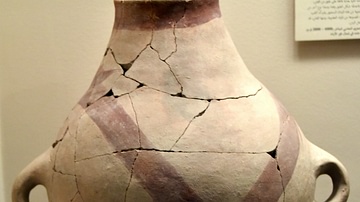
Decorated Pottery Jar from Abu Hamid
This type is similar to the ones used for infant burials, but this one is painted with red strips using iron oxide (hematite), material already known during the Neolithic period for coloring plaster. The Jar was...
Image
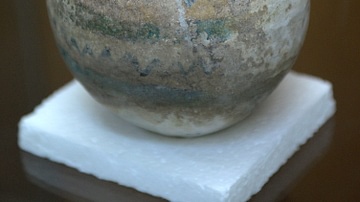
Colorful Jar from Assyria
The decorative paintings on this pottery jar can still be seen. From northern Mesopotamia, modern-day Iraq. Neo-Assyrian perod, 911-609 BCE. The Sulaymaniyah Museum, Iraq.
Image
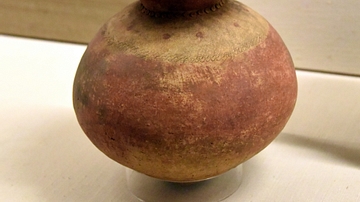
Yayoi Jar with Beaded Neck
This jar has small beads around the neck and is decorated with red pigment and cord impressions. As regional rulers became more powerful in the Yayoi period, they demanded higher quality ceramics. Warfare also became more...
Image
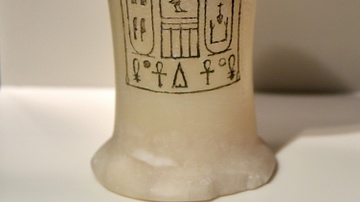
Jar of Pepi II
This calcite-alabaster jar (probably was a container for cosmetic oil) is inscribed with four royal titulary names of the Egyptian Pharaoh Pepi II (2284 - c. 2216 BCE). On the left is the nomen (birth name) of Pepi II. On the right...
Image
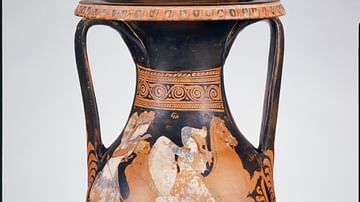
Wine Jar with Greeks Fighting Amazons
Red-figure wine jar decorated with a battle between Amazons and Greeks. Attributed to the Amazon Painter, mid-4th century BCE. Attica. 43.2 cm (17 in) in height. (Metropolitan Museum of Art)
Image
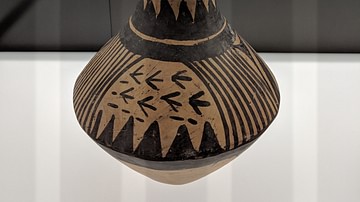
Jar With Stylized Landscape, Majiayao Culture
A pottery jar with stylized landscape from Gansu or Qinhai Province, China. Produced by the Majiayao Culture, late 4th / early 3rd millennium BCE.
Exhibited at Museum Rietberg, Zurich, Switzerland.

Image
Merovingian Jar
The Franks continued to produce glass vessels and wheel-made pottery using Roman methods, but the finer skills were lost and glassware became a luxury, used only at high status feasts. Roman glass-making centers in the Rhineland...
Image
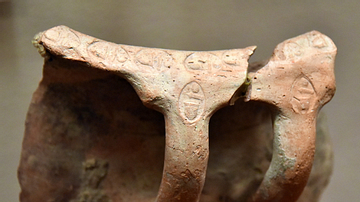
Stamped Pottery Jar from Tell al-Khulayfi
An oval seal impression repeated on the rim and handles of a large jar. Seal impressions are official guarantees of the jars and their contents; therefore, stamped jars indicated the presence of a local administrative...
