
Search
Remove Ads
Advertisement
Search Results

Definition
Colossus of Rhodes
The Colossus of Rhodes was a gigantic 33-metre-high bronze statue of the sun god Helios which stood by the harbour of that city from c. 280 BCE. Rhodes was then one of the most important trading ports in the ancient Mediterranean...

Definition
Ancient Egyptian Literature
Ancient Egyptian literature comprises a wide array of narrative and poetic forms including inscriptions on tombs, stele, obelisks, and temples; myths, stories, and legends; religious writings; philosophical works; wisdom...

Definition
Konarak Sun Temple
The Konark or Konarak Sun temple is dedicated to the Hindu sun god Surya, and, conceived as a giant stone chariot with 12 wheels, it is the most famous of the few sun temples built in India. It is located about 35 km northeast...

Definition
Geghard
Geghard (Armenian: Geghardavank or "monastery of the spear") is a medieval monastery located in Armenia's Kotayk province, deep within the Azat Valley, which was built directly out of an adjacent mountain. Geghard is renown throughout...

Definition
Benvenuto Cellini
Benvenuto Cellini (1500-1571 CE) was an Italian Renaissance sculptor, medallist, and goldsmith whose most famous works today include the bronze statue of Perseus holding the head of Medusa, which now stands in Florence, and a...

Definition
Taj Mahal - Symbol of Love, Power, & Mughal Architecture
The Taj Mahal is a mausoleum complex in Agra, Uttar Pradesh, northern India. Commissioned by the Mughal Emperor Shah Jahan to inter and memorialise his wife Mumtaz Mahal, the building is the finest...
Definition
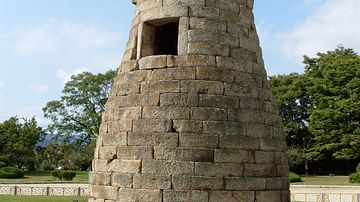
Cheomseongdae
Cheomseongdae (Chomsongdae) is a 7th-century CE observatory tower located in Gyeongju, the capital of the Silla Kingdom of ancient Korea. It is the oldest surviving astronomical observatory in East Asia and is listed as no. 31 on...

Definition
Kofun
Kofun (old tumuli) are large artificial mound tombs built in ancient Japan for the ruling elite between the 3rd and 7th century CE. Many measure several hundred metres across, are surrounded by a moat, and, besides containing valuable...

Definition
Hindu Architecture
Hindu architecture evolved over the centuries from simple rock-cut cave shrines to massive and ornate temples which spread across the Indian sub-continent and beyond, forming a canonical style which is still adhered to today...

Definition
The Pillow Book
The Pillow Book (Makura no Soshi) is a personalised account of life at the Japanese court by Sei Shonagon which she completed c. 1002 CE during the Heian Period. The book is full of humorous observations (okashi) written in the...
