
Search
Remove Ads
Advertisement
Search Results

Definition
Ancient Egyptian Architecture
Ancient Egyptian architecture is often associated closely with the pyramids of Giza but was actually quite diverse, taking a number of forms in the construction of administrative buildings, temples, tombs, palaces...

Definition
Hans Holbein the Younger
Hans Holbein the Younger (c. 1497-1543 CE) was a German Renaissance painter who is most famous for his portraits. A versatile artist and superb draughtsman, Holbein was accomplished in different mediums from woodcut engravings...

Definition
Japanese War Tales
War tales (gunki monogatari) is a genre of historical writing that developed in Japan from the Heian Period (794-1185) to the Muromachi Period (1333-1573). They form an important element in the development of the Japanese literary...

Definition
Ancient Egyptian Government
The government of ancient Egypt was a theocratic monarchy as the king ruled by a mandate from the gods, initially was seen as an intermediary between human beings and the divine, and was supposed to represent the gods'...

Definition
Atalanta - The Huntress of Greek Mythology
Atalanta is a figure from Greek mythology famed as a huntress, wrestler, and runner. The heroine was a key participant in the Calydonian boar hunt, striking the first wound in this fearsome beast with her bow...

Definition
Eros
Eros was the Greek god of love, or more precisely, passionate and physical desire. Without warning Eros selects his targets and forcefully strikes at their hearts, bringing confusion and irrepressible feelings. In the words of Hesiod...

Definition
Siren - The Woman-Bird Creatures of Greek Mythology
Sirens were creatures from Greek mythology that enticed sailors to their destruction with their irresistibly beautiful singing. The most famous appearance of sirens in literature is in Homer's Odyssey...

Definition
Hephaistos
Hephaistos (Hephaestus) was the ancient Greek god of fire, metallurgy, and crafts. He was the brilliant blacksmith of the Olympian gods, for whom he fashioned magnificent houses, armour, and ingenious devices. Hephaistos had his workshop...

Definition
Teotihuacan
Teotihuacan, located in the Basin of Central Mexico, was the largest, most influential, and most revered city in the history of the New World. It flourished in Mesoamerica's Golden Age, the Classic Period of the first millennium CE...
Definition
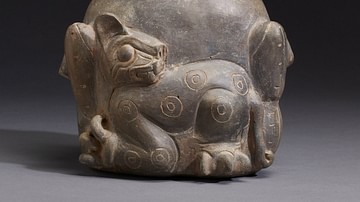
Chavin Civilization
The Chavin civilization flourished between 900 and 200 BCE in the northern and central Andes and was one of the earliest pre-Inca cultures. The Chavin religious centre Chavin de Huantar became an important Andean pilgrimage...
