
Search
Remove Ads
Advertisement
Search Results

Definition
Roman Auxiliary Cavalry
The Roman army consisted of three separate divisions: the famed legions, the cavalry, and lastly, the auxiliaries. The auxiliaries (auxilia) were comprised of infantry cohorts, mounted infantry, and cavalry units or wings...

Article
Saratoga Campaign
The Saratoga Campaign (20 June to 17 October 1777) was one of the most important military campaigns of the American Revolutionary War (1775-1783), in which a British army under General John Burgoyne invaded the Hudson River Valley...

Article
The Fall of the Alamo: Eyewitness Accounts - Created History and Forgotten Witnesses
There were around 15 non-combatants in the Alamo who survived the battle on the morning of 6 March 1836 and, among these, were two who became famous for their first-hand accounts...

Collection
Battles of the Roman Empire
The Roman Empire was forged through warfare and in this collection we look at some of the key battles and revolts that shaped its borders from the reign of Augustus onwards. We look at Varus' shocking defeat at the Battle...

Image
Kylix with Battle Scene
A kylix is a Greek wine drinking-cup which was primarily used at a drinking party (symposium). In this balanced design, the Triptolemos painter (an ancient Greek vase painter) creatively separated the crumpled figure of...
Image
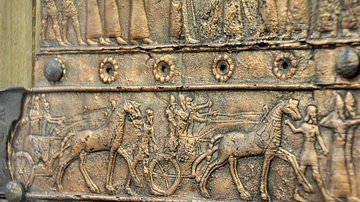
Battle Scene, Balawat Gate
Detail of the bronze casing of the Balawat gate showing war chariots. From Balawat (Imgur-Enlil), northern Mesopotamia, Iraq. Neo-Assyrian Period, reign of King Shalmaneser III, 858-824 BCE. (Ancient Orient Museum/Istanbul...
Image
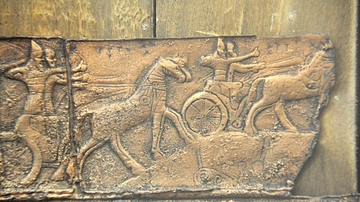
Royal Chariots in Battle, Balawat Gate
Detail of the bronze casing of the Balawat gate. From Balawat (Imgur-Enlil), northern Mesopotamia, Iraq. Neo-Assyrian Period, reign of King Shalmaneser III, 858-824 BCE. (Ancient Orient Museum/Istanbul Archaeological...

Image
Assyrian Battle Scene
Assyrian relief, from the Central Palace at Nimrud (ancient Kalhu), Mesopotamia, modern-day Iraq; reused later in the South-West Palace, from the reign of Tiglath-Pileser III, c. 728 BCE. An enemy horseman is ridden down...

Image
Illyrian Helmet from the Battle of Plataea
This helmet, beaten from a single sheet of bronze, features hammered out (repoussé) ridges along the top. The Illyrian type is found in mainland Greece and former Yugoslavia, dating from the 6th to early 5th...

Image
Metope with Pyrrhus in Battle
Found at Tomb I, Via Umbria, Taranto, Italy. This metope from the late 3rd to early 2nd century BCE decorated a temple-like tomb in the tradition of Macedonian kings and borrowing imagery from Alexander the Great's...
